IPv6 and DNS
Name resolution in a network with IPv6
Carsten Strotmann
Created: 2025-01-30 Thu 09:40
Agenda
- IPv6 support in DNS Server
- The IPv6 AAAA Address Record
- Reverse Lookup
- DNS and IPv6 pitfalls
- Resolver configuration
- IPv6 in URLs
IPv6 and DNS
IPv6 Transport and IPv6 Payload
- There are two things to adhere with DNS and IPv6
- IPv6 can be the transport protocol to send IPv4 and IPv6 DNS payload
- IPv6 Resource Records served by a name server
- Both can be used independently
- Answer queries for IPv6 Address(AAAA) Requests over IPv4
- Answer queries to IPv4 Address (A) Requests over IPv6
IPv6 Support in DNS server software
DNS Resolver
- BIND 9 from ISC
- Windows DNS (since 2008) from Microsoft
- Unbound from NLnetLabs
- PowerDNS Recursor from PowerDNS B.V.
- Knot-Resolver from cz.nic
Authoritative DNS Server
- BIND 9 from ISC
- Windows DNS (since 2008) from Microsoft
- NSD from NLnetLabs
- PowerDNS from PowerDNS B.V.
- Knot from cz.nic
The IPv6 Address Record
AAAA - the IPv6 Address Record
- IPv6 Addresses are stored using AAAA (Quad-A) Records
- The AAAA Record is similar to the IPv4 Address Record, just use an IPv6 Address notation (RFC 3596 DNS Extensions to Support IP Version 6)
AAAA - the IPv6 Address Record
$TTL 3600
example.org.     IN SOA  dns1.example.com. hostmaster.example.org. (
                                20210816   ; serial
                                      1d   ; refresh
                                      2h   ; retry
                                     40d   ; expire
                                      2h ) ; neg TTL
example.org.      IN NS   dns1.example.com.
example.org.      IN NS   dns2.example.com.

example.org.      IN MX   10 mail.example.org.
www.example.org.  IN A    192.0.2.44
www.example.org.  IN AAAA 2001:db8:100::66

mail.example.org. IN AAAA 2001:db8:100:0:AF:999:A800:1
mail.example.org. IN A 192.0.2.42
What about the A6 Record?
- The A6 Resource Record (RFC 2874, aimed to ease renumbering of IPv6 Networks) is not used anymore
- However if you sniff the network, you might see A6 queries from older operating systems
- See RFC 6563 (March 2012): “Moving A6 to Historic Status”
The HTTPS Record
- The
HTTPSrecord is a relatively new record. It's type number is 65 (aka TYPE65)- It has been first observed "in the wild" in Summer 2020
- It is being used in the new Apple operating systems (iOS, iPadOS, macOS) since fall 2020
- It is now the 3rd most queried DNS record in the Internet (after
AandAAAA) - RFC 9460 - Service Binding and Parameter Specification via the DNS (SVCB and HTTPS Resource Records) (Nov 2023)
The HTTPS Record
- The
HTTPSdelivers connection information for an HTTPS service- IPv4-Addresses of the service
- IPv6-Addresses of the server
- The public key of the server to be used to initiate an encrypted TLS "client hello"
- Protocol selection: HTTP/2 (TCP) or HTTP/3 (QUIC)
- One or more DoH-Resolver for the service
The HTTPS Record
- Example of a
HTTPSRecord for a service offering HTTP/2 and HTTP/3 (preferred)
example.com 3600 IN HTTPS 1 . alpn=”h3,h2”
The HTTPS Record
- Example of a
HTTPSRecord for a service with both IPv4 and IPv6 Addresses
example.com 3600 IN HTTPS 1 . alpn=”h3,h2” (
           ipv4hint=”192.0.2.1”
           ipv6hint=”2001:db8::1”
           )
The HTTPS Record
- Benefits of the HTTPS records
- Browser don't need to request explicit IPv6 and IPv4 Addresses (faster connection)
- The
HTTPSRecords is a signal to the web-browser to only allow TLS secured/encrypted connections for this domain name. This prevents downgrade attacks (DNSSEC recommended!). - With the
HTTPSRecord it is possible to create Domain-Alias definitions for whole zones (not possible with theCNAMERecord)
The HTTPS Record
- The BIND 9 DNS server and tools (
dig,host) support theHTTPSrecord since version 9.16.21 (September 2021)
Happy Eyeballs v3 the HTTPS DNS-Record
- The HTTPS-Record (RFC 9460) in DNS can give applications guidance on which IP protocol to choose
- The IETF is working on a 3rd iteration on Happy Eyeballs to take HTTP/3 and the HTTPS record into account: "Happy Eyeballs Version 3: Better Connectivity Using Concurrency"
Reverse Lookup
IPv6 PTR Records
- Domain-Names in Reverse Zones for IPv6 Addresses are stored using normal PTR (Pointer) Records
- In the Owner-name, the IPv6 IP Address is written in reverse order and in hexadecimal Nibble Notation (Nibble = 4bit)
- The second-level domain for IPv6 Reverse zones is
ip6.arpa. - Pre-population of IPv6 reverse zones is not feasible
- there are too many IPv6 addresses in one /64 subnet
- Reverse DNS name resolution is optional for most applications and protocols
Example reverse DNS zone
$TTL 3600
$ORIGIN 0.0.0.0.0.0.1.0.8.b.d.0.1.0.0.2.ip6.arpa.
@            IN SOA  dns1.example.org. hostmaster.example.org. (
                                20210116   ; serial
                                      1d   ; refresh
                                      2h   ; retry
                                     40d   ; expire
                                      2h ) ; neg TTL
             IN NS  dns1.example.org.
             IN NS  dns2.example.org.

6.6.0.0.0.0.0.0.0.0.0.0.0.0.0.0 IN PTR     www.example.com.
1.0.0.0.0.0.8.a.9.9.9.0.f.a.0.0 IN PTR     mail.example.com.
Strategies for IPv6 reverse zones
- Several real-world solutions for populating an IPv6 reverse zone exist:
- Manually manage PTR records (for important machines)
- Update PTR records from DHCPv6
- Update PTR records from an IP Address Management System
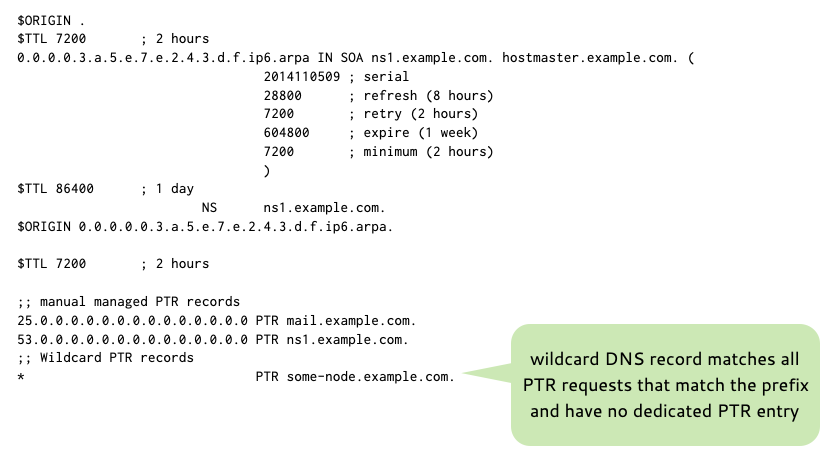
- Use DNS Wildcards to provide generic PTR records
Example DNS wildcard use
DNAME records
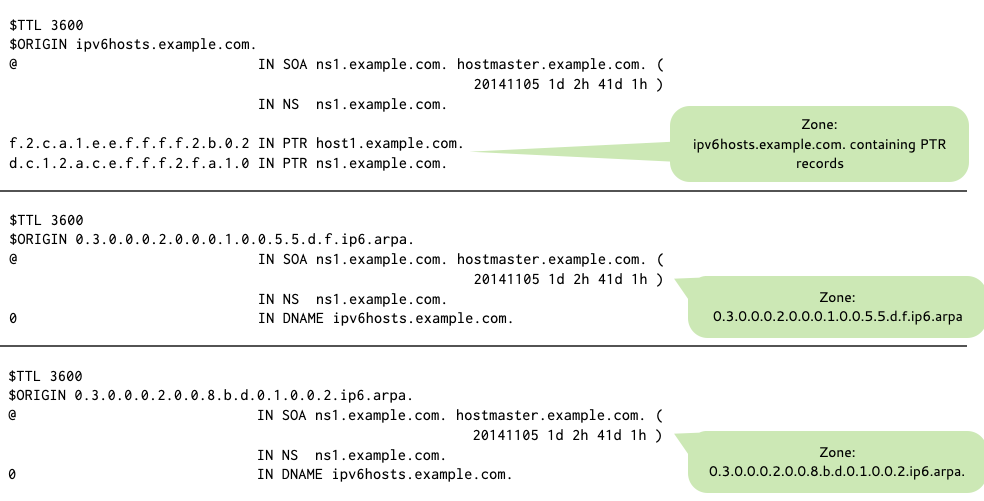
- DNAME records (RFC 6672) redirects a non-delegated subtree on an existing namespace
- Like CNAME, but for all names below a domain-name
- Can be used to map one IPv6 reverse zone over another (given that the host-ids are identical for both IPv6 network prefixes)
- Example: the ULA Prefix
fd55:10:20:30::/64and the GUA Prefix2001:db8:20:30::/64contain the same machines- With DNAME, only one reverse zone need to be maintained
Example DNAME records
DNS Data and IPv6
IPv6 Addresses to be published in DNS
- on public authoritative DNS server:
- Global Unicast Addresses
- on private internal authoritative DNS server (not visible to the public Internet):
- Global Unicast Addresses
- Multicast addresses
- Unique-local addresses
Service Names in DNS
- It is recommended that you publish service names in DNS in addition to host-names
- SRV records are not widely supported in applications
- Separates the service function from the physical machine
- Use
HTTPSrecords for web-services
- Example Hostname:
m68112.datacenter.la.example.com - Example Service-Name:
www.example.com
IPv6 Addresses not to be published in DNS
- Link-local addresses
- Temporary addresses (privacy extensions)
- Teredo/Tunnel Addresses
TTL for IPv6 and IPv4 service names in DNS
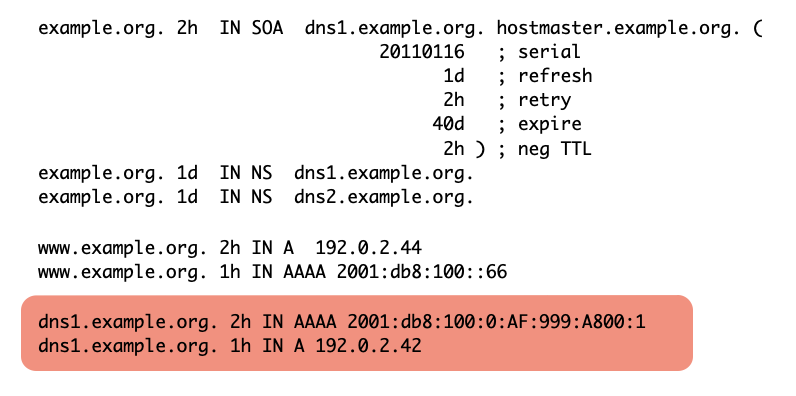
- If IPv4 and IPv6 Address records are present for the same
service, the TTL of the records should be identical
- Especially important for critical additional data, such as addresses of DNS Servers (NS-Records)
- Glue-Records (AAAA/A-Records for delegation NS-Records) will not be queried on-demand by DNS resolver. Having different TTL between A and AAAA records can lead to nameserver only reachable over one IP protocol.
Example: Bad use of TTL
IPv6 for authoritative DNS Server
- Most DNS server software can run on a dual stack machines (IPv4 and IPv6)
- Name server should be able to communicate over IPv4 as long as many Addresses and Internet Name server are still on IPv4
- Most ccTLD and gTLD DNS server are available on IPv6 networks
IPv6 and DNS round robin
- DNS round robin is used in pure IPv4 networks to create a "poor
mans load distribution"
- It makes use of the fact that many applications only choose the topmost address record from a record set
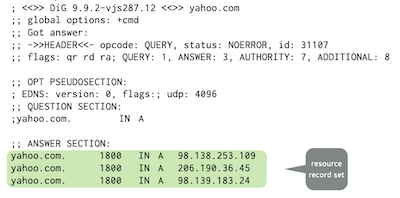
IPv6 and DNS round robin
- IPv6 nodes sort all destinations received from DNS to select a
destination to use
- This applies to IPv4 and IPv6 addresses and it disables DNS round robin selection for IPv4.
- DNS Round Robin and Destination IP address selection (Archived version from MS Technet)
- RFC 6724 "Default Address Selection for Internet Protocol Version 6 (IPv6)"
DNS Client support
Provisioning the DNS resolver addresses
- With IPv6, the DNS resolver addresses for a client can be configured …
- Manual
- Using DHCP (v4/v6)
- Through Router Advertisements (RDNSS, RFC 6106)
- see RFC 4339 - "IPv6 Host Configuration of DNS Server Information Approaches"
Dynamic Updates
- Windows OS IPv6 clients can get their IPv6 Address by
Auto-configuration (SLAAC) and register themselves in DNS
- There is no equivalent function in an Unix stub-resolver today to enter this Information into DNS (forward and reverse zones)
- RFC 9686 style IP address registration towards a DHCPv6 server
opens the option to use the DHCPv6 server as a dynamic DNS
proxy
- The SLAAC client will register it's addresses towards the DHCPv6 server, the DHCPv6 server will update the name to address binding in DNS
Applications & IPv6
Applications & IPv6
- Not all Applications can use IPv6 Addresses or can communicate over IPv6
- Services on hosts with AAAA Addresses should be able to use IPv6
- Recommendation: During initial test and IPv6 deployment, configure a separate subdomain for IPv6 enabled hosts and services.
- Example:
- Web-Service on IPv4:
www.example.com - Web-Service on IPv6:
www.ip6.example.com
- Web-Service on IPv4:
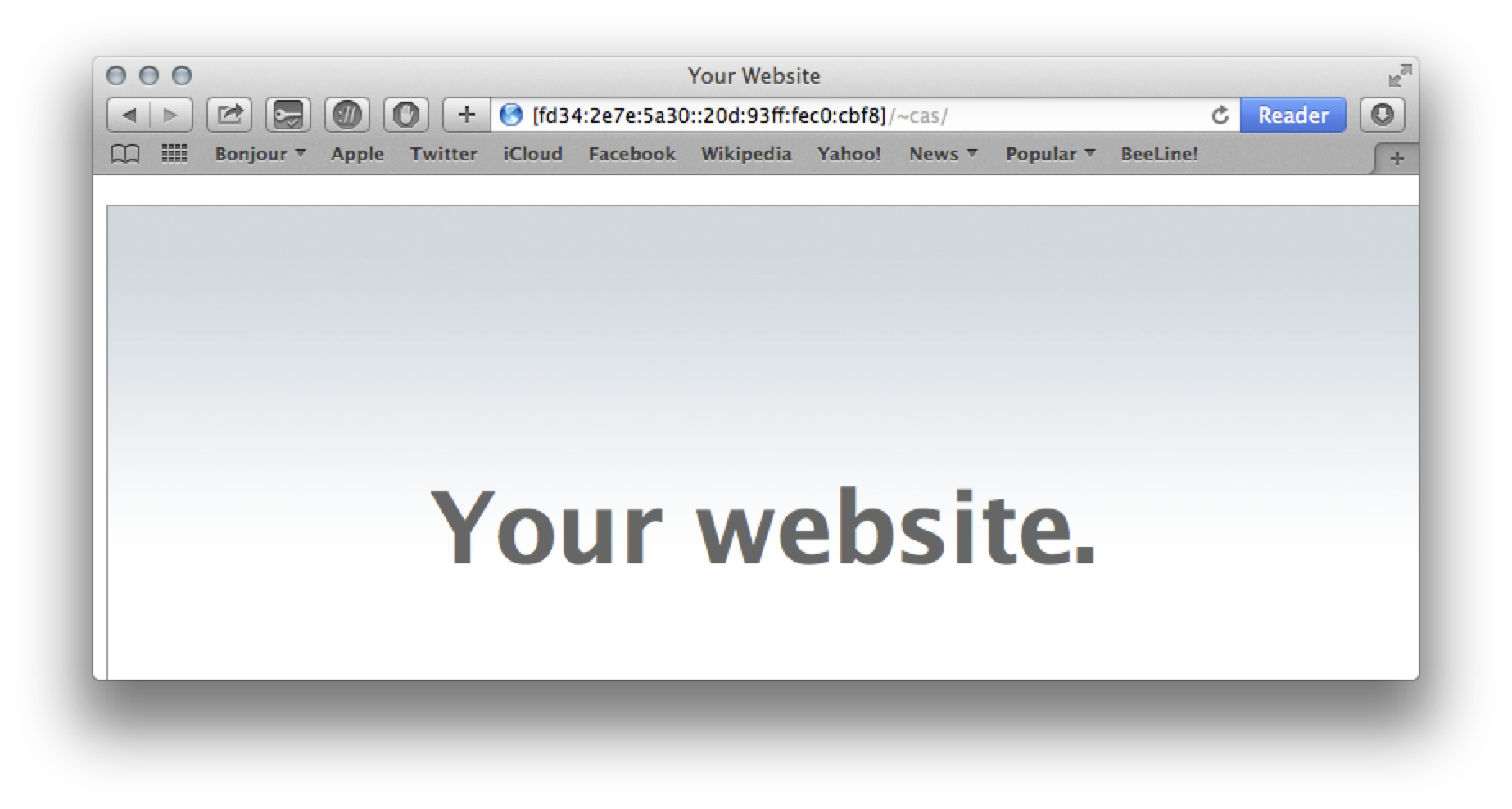
Literal IPv6 addresses in URLs
Literal IPv6 addresses in URLs must be enclosed in brackets. To reach a web-server on the IPv6 address
2001:db8::2:3:4use the URLhttps://[2001:db8::2:3:4]:443/index.html- This is not intended for “End-Users”
- But is helpful for Administrators and for Troubleshooting
Literal IPv6 addresses in URLs
Literal IPv6 addresses in URLs
- RFC 6874 specifies how to encode a zone identifier in URLs
- Zone identifiers are needed on link-local scoped IPv6 addresses
- Zone identifiers are separated from the IPv6 address by a encoded "%" sign: %25
- Example:
https://[fe80::226:b0ff:fed6:a4e0%25en0]:8088/index.html
ipv6-literal.net
- Many „legacy“ applications cannot handle IPv6 addresses, but they can work with DNS Names
- For legacy applications on modern Windows operating systems
(Vista, 7, 8, 10, 11): IPv6 addresses can be entered as DNS names
- To turn an IPv6 address into a DNS Name, all colons
:in the address must be replaced by dashes-… - … and the 2nd level domain
ipv6-literal.netmust be appended
- To turn an IPv6 address into a DNS Name, all colons
ipv6-literal.net
- A Windows TCP/IP Stack will not send these DNS Names ending in
ipv6-literal.netto a resolver, instead it will connect directly to the derived IPv6 address. - Example: IPv6 Address
2001:db8:0:0:0:0:fea:1is converted into the pseudo name2001-db8-0-0-0-0-fea-1.ipv6-literal.net.
IPv6, e-mail and DNS
MX Records
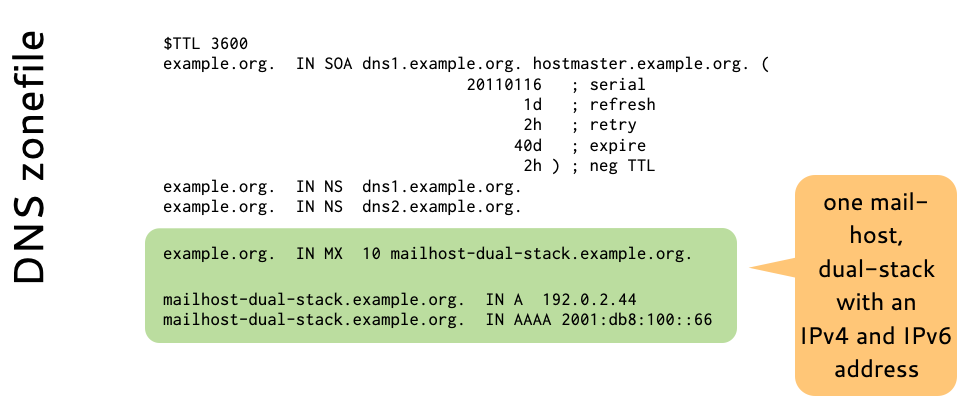
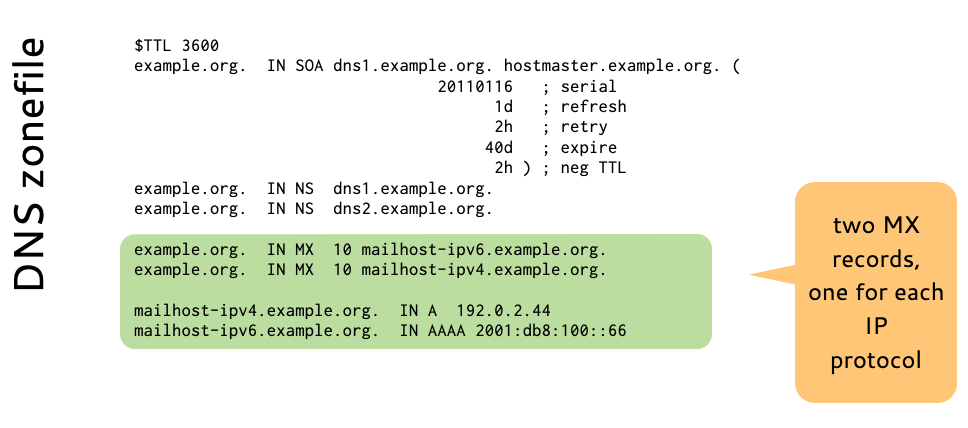
- For receiving E-Mail over IPv6
- The mail server must listen on an IPv6 address
- The mail-host part of the MX record must resolve into an IPv6
address =
AAAADNS record
- For the
MXrecord we have a choice- Generic
MXrecord, mail-host resolves into bothAandAAAArecord(s) (IPv4 and IPv6) - Separate
MXrecords for IPv4 and for IPv6
- Generic
MX-Records and IPv6
MX-Records and IPv6
DNS IPv6 issues
Old DNS-Server and Load-Balancer
- Some (very old) DNS server and some (not so old) DNS load balancer
products do not respond correctly when seeing a AAAA record query
- They ignore the query
- They sending a NAME ERROR (NXDOMAIN)
- Return the AAAA record with an IPv4 address
- Other wrong answers
- Wrong or no answer on AAAA in some cases can cause a connection failure when IPv4 transit (and DNS) would work correctly
- For example, a web browser that fails to connect to a web server it could otherwise reach (via IPv4)
IPv6 and Fragmentation (1)
- DNS, as designed in 1983 (RFCs 1034, 1035 & 1036), had a limitation of 512-Byte DNS payload over UDP.
- The 512B limitation was lifted with the EDNS0 extension, RFC 2671 (Aug 1999) and RFC 6891 (April 2013).
- UDP DNS answers > 1280 byte can cause fragmentation
- IPv6 fragmentation is broken in the Internet: RFC 7872 - Observations on the Dropping of Packets with IPv6 Extension Headers in the Real World
IPv6 and Fragmentation (2)
- Based on the research by Roland van Rijswijk (SURFnet) the recommendation is:
- At least 50% of all authoritative DNS servers for a zone should limit the advertised EDNS0 payload to 1232 bytes
- At least 50% of all in-zone authoritative DNS server for a zone should limit the advertised EDNS0 payload to 1232
- Authoritative DNS servers for the zone MUST respond to queries over TCP transport protocol
- These recommendations are now the default for DNS server software since DNS Flag Day 2020.
IPv6 DNS troubleshooting
- Modern DNS troubleshooting tools support IPv6
dig,delv,host(BIND 9)drill(ldns)unbound-host(unbound)
- Avoid the old, unmaintained and obsolete
nslookup
DNS Query examples
Example DNS Query
- Asking for IPv6 addresses:
# dig aaaa www.isc.org

; <<>> DiG 9.9.5 <<>> aaaa www.isc.org
;; global options: +cmd
;; Got answer:
;; ->>HEADER<<- opcode: QUERY, status: NOERROR, id: 61098
;; flags: qr rd ra ad; QUERY: 1, ANSWER: 1, AUTHORITY: 4, ADDITIONAL: 7

;; OPT PSEUDOSECTION:
; EDNS: version: 0, flags:; udp: 4096
;; QUESTION SECTION:
;www.isc.org.			IN	AAAA

;; ANSWER SECTION:
www.isc.org.		60	IN	AAAA	2001:4f8:0:2::69

;; AUTHORITY SECTION:
isc.org.		7200	IN	NS	ns.isc.afilias-nst.info.
isc.org.		7200	IN	NS	ord.sns-pb.isc.org.
isc.org.		7200	IN	NS	sfba.sns-pb.isc.org.
isc.org.		7200	IN	NS	ams.sns-pb.isc.org.

;; ADDITIONAL SECTION:
ams.sns-pb.isc.org.	7200	IN	A	199.6.1.30
ams.sns-pb.isc.org.	7200	IN	AAAA	2001:500:60::30
ord.sns-pb.isc.org.	7200	IN	A	199.6.0.30
ord.sns-pb.isc.org.	7200	IN	AAAA	2001:500:71::30
sfba.sns-pb.isc.org.	7200	IN	A	149.20.64.3
sfba.sns-pb.isc.org.	7200	IN	AAAA	2001:4f8:0:2::19

;; Query time: 622 msec
;; SERVER: 127.0.0.1#53(127.0.0.1)
;; WHEN: Mon Oct 27 14:20:12 CET 2014
;; MSG SIZE  rcvd: 299
Example DNS Query
- Asking for names of an IPv6 address (Reverse DNS lookup)
# dig -x 2001:4f8:0:2::19

; <<>> DiG 9.9.5 <<>> -x 2001:4f8:0:2::19
;; global options: +cmd
;; Got answer:
;; ->>HEADER<<- opcode: QUERY, status: NOERROR, id: 37284
;; flags: qr rd ra ad; QUERY: 1, ANSWER: 1, AUTHORITY: 4, ADDITIONAL: 1

;; OPT PSEUDOSECTION:
; EDNS: version: 0, flags:; udp: 4096
;; QUESTION SECTION:
;9.1.0.0.0.0.0.0.0.0.0.0.0.0.0.0.2.0.0.0.0.0.0.0.8.f.4.0.1.0.0.2.ip6.arpa. IN PTR

;; ANSWER SECTION:
9.1.0.0.0.0.0.0.0.0.0.0.0.0.0.0.2.0.0.0.0.0.0.0.8.f.4.0.1.0.0.2.ip6.arpa. 7200 IN PTR sfba.sns-pb.isc.org.

;; AUTHORITY SECTION:
8.f.4.0.1.0.0.2.ip6.arpa. 7200	IN	NS	sec2.authdns.ripe.net.
8.f.4.0.1.0.0.2.ip6.arpa. 7200	IN	NS	ord.sns-pb.isc.org.
8.f.4.0.1.0.0.2.ip6.arpa. 7200	IN	NS	sfba.sns-pb.isc.org.
8.f.4.0.1.0.0.2.ip6.arpa. 7200	IN	NS	ams.sns-pb.isc.org.

;; Query time: 932 msec
;; SERVER: 172.22.1.22#53(172.22.1.22)
;; WHEN: Mon Oct 27 14:22:32 CET 2014
;; MSG SIZE  rcvd: 219
Example DNS Query
- Sending a query towards a DNS server via IPv6:
# dig -6 @sec2.authdns.ripe.net. 8.f.4.0.1.0.0.2.ip6.arpa. soa

; <<>> DiG 9.9.5 <<>> -6 @sec2.authdns.ripe.net. 8.f.4.0.1.0.0.2.ip6.arpa. soa
; (1 server found)
;; global options: +cmd
;; Got answer:
;; ->>HEADER<<- opcode: QUERY, status: NOERROR, id: 44834
;; flags: qr aa rd; QUERY: 1, ANSWER: 1, AUTHORITY: 4, ADDITIONAL: 1
;; WARNING: recursion requested but not available

;; OPT PSEUDOSECTION:
; EDNS: version: 0, flags:; udp: 4096
;; QUESTION SECTION:
;8.f.4.0.1.0.0.2.ip6.arpa.	IN	SOA

;; ANSWER SECTION:
8.f.4.0.1.0.0.2.ip6.arpa. 7200	IN	SOA	ns-int.isc.org. hostmaster.isc.org. 2014102100 28800 1800 2592000 3600

;; AUTHORITY SECTION:
8.f.4.0.1.0.0.2.ip6.arpa. 7200	IN	NS	ams.sns-pb.isc.org.
8.f.4.0.1.0.0.2.ip6.arpa. 7200	IN	NS	sfba.sns-pb.isc.org.
8.f.4.0.1.0.0.2.ip6.arpa. 7200	IN	NS	ord.sns-pb.isc.org.
8.f.4.0.1.0.0.2.ip6.arpa. 7200	IN	NS	sec2.authdns.ripe.net.

;; Query time: 63 msec
;; SERVER: 2001:67c:e0::4#53(2001:67c:e0::4)
;; WHEN: Mon Oct 27 14:25:05 CET 2014
;; MSG SIZE  rcvd: 211
Quiz
- An IPv6 enabled application that runs on a dual stack operating
system wants to connect to
somehost.example.com.- It will send a DNS query for
Arecord forsomehost.example.comANYrecord forsomehost.example.comAAAArecord forsomehost.example.com- both
AAAAandArecords forsomehost.example.com HTTPSrecord forsomehost.example.com
Questions?