IPv6 Fundamentals
Leaving the chains of IPv4 behind
Carsten Strotmann
Created: 2025-01-27 Mon 08:46
Agenda
- IPv6 in 2025
- IPv6 challenges or "why don't we have it everywhere?"
- IPv6 Addressing
IPv6 in 2025
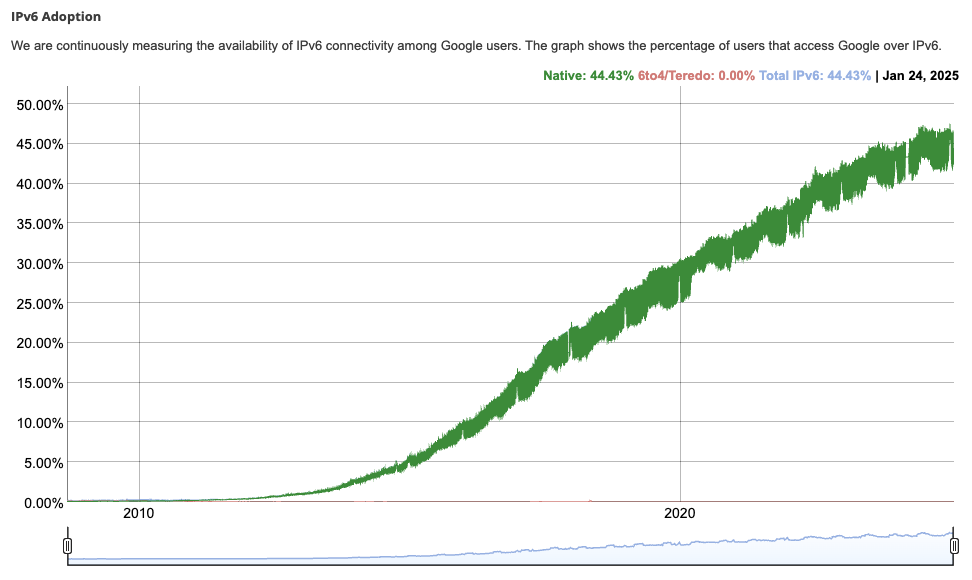
IPv6 as seen by Google
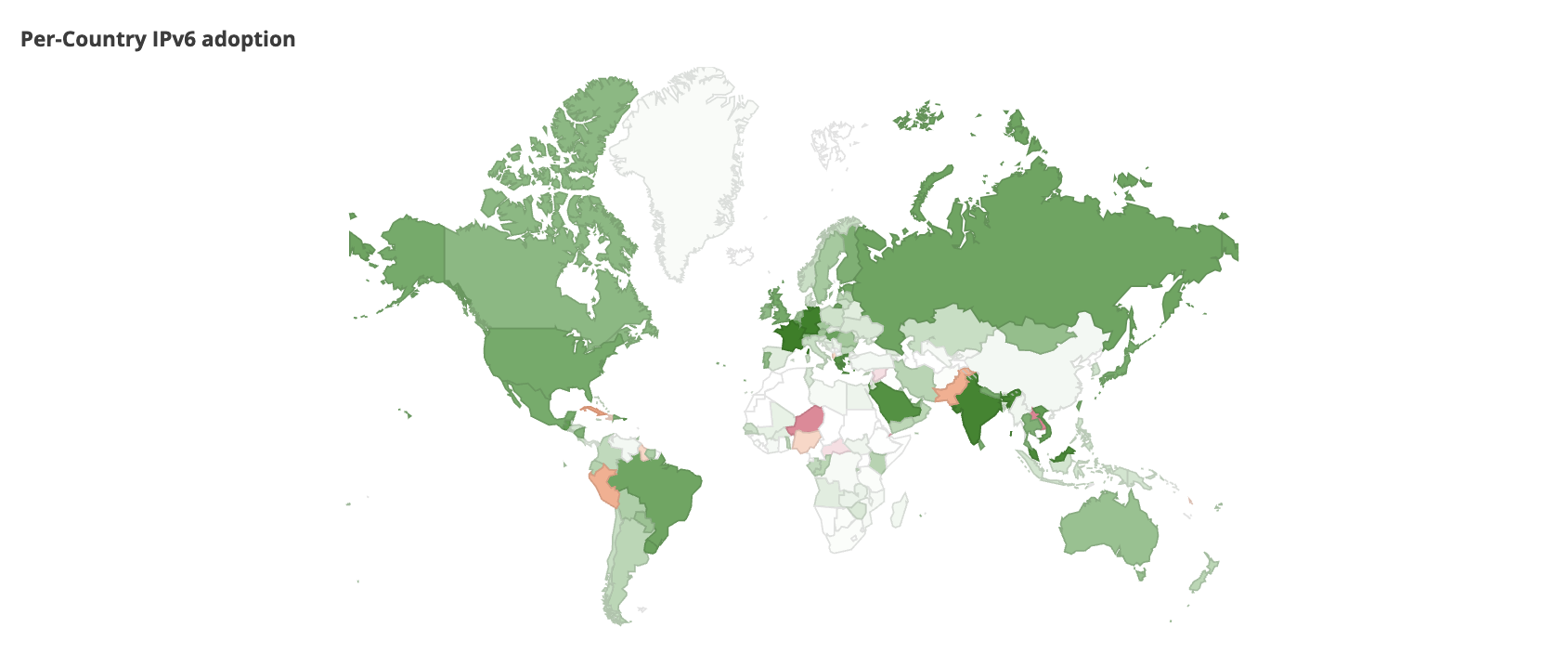
IPv6 by country as seen by Google
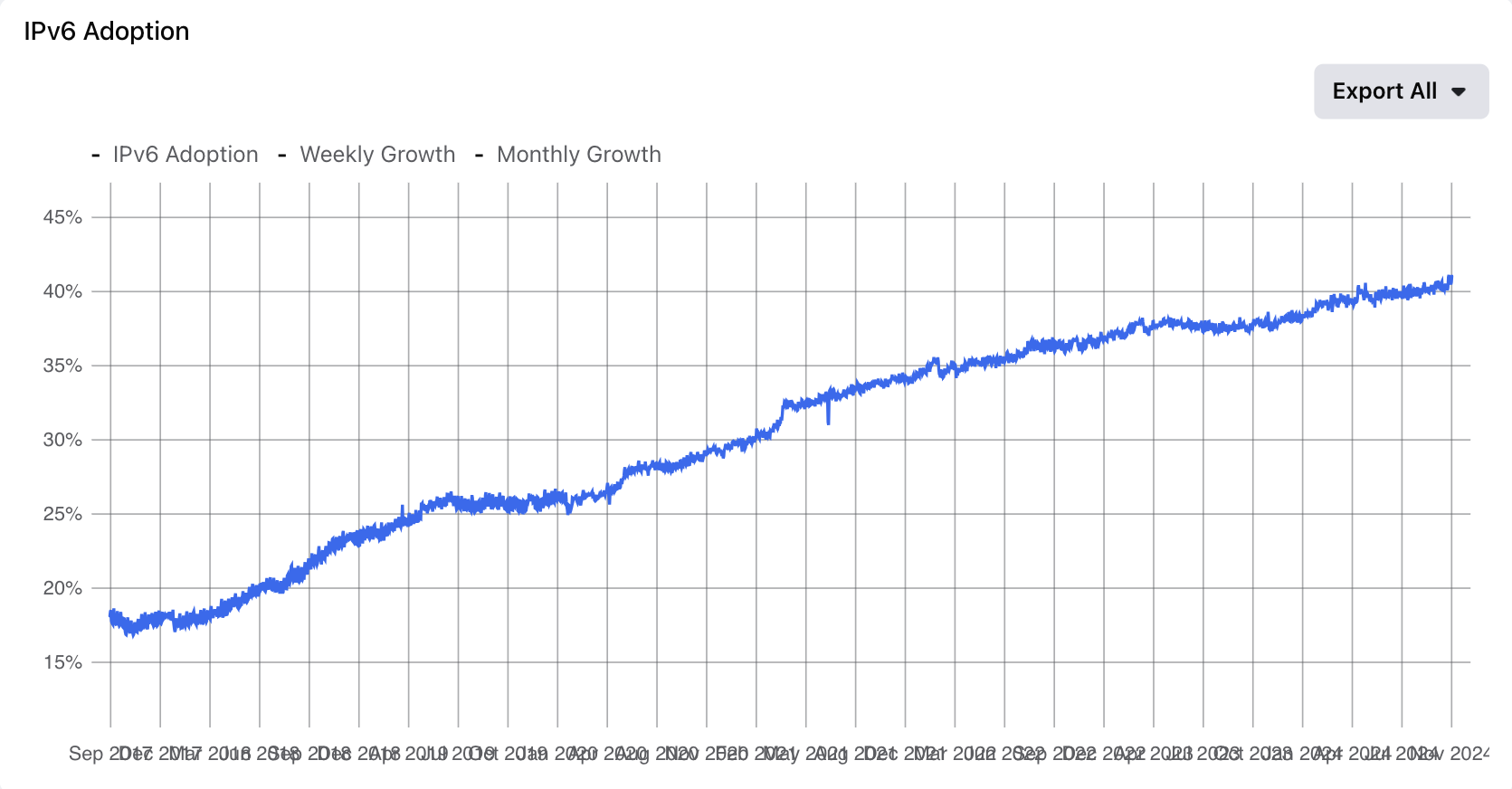
IPv6 as seen by Facebook
Anatomy of IPv6 projects
IPv6 challenges
- IPv6 is as much a human challenge as it is a technical challenge
- People are opposed to change
- IPv6 changes may break things in the network
IPv6 challenges
- IPv6 cannot be a "side project"
- It must have management attention and must be 100% backed by management
IPv6 challenges
- What will happen when introducing IPv6 to a network
- There will be friction
- There will be errors and breakage
- Administrators/developers must have a safe environment to be able to innovate with IPv6
IPv6 Benefits
IPv6 Benefits
- Flexibility
- Modern IETF protocols building on IPv6 (but not IPv4)
- Lean network management and planning
IPv6 Benefits
- Less load on Firewalls (no NAT for UDP based video-conferencing)
- Simpler firewall rules -> less complexity
- Better latency (XBox gaming …)
- Stability (IPv4-as-a-service is getting brittle)
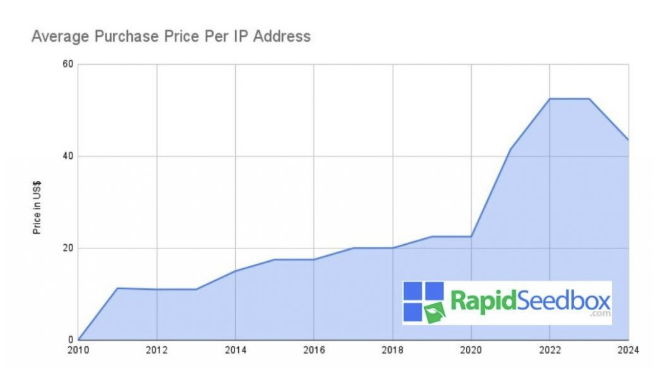
- Less costs per IP addresses (IPv4 = ~ 35-60 US$ / IPv6 = 0 US$)
IPv4 in 2025
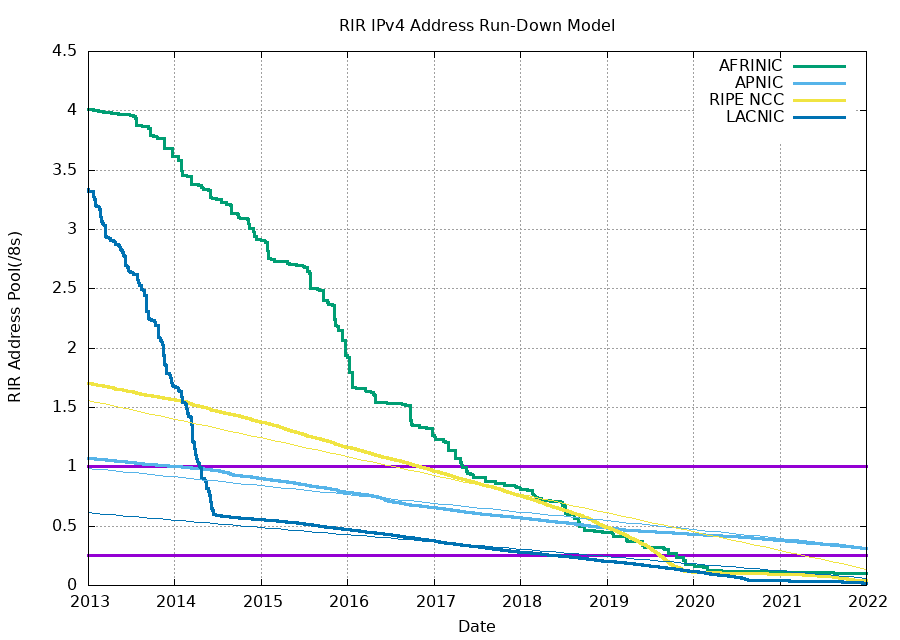
- The last IPv4 blocks were given out to the RIRs by IANA on February 1st, 2011
- ARIN run out of IPv4 addresses in 2015
- RIPE run out of IPv4 addresses in 2020
- LACNIC run out of IPv4 addresses in 2020
- APNIC and AFRINIC are low on the last /8 block
IPv4 in 2025
IPv4 address costs
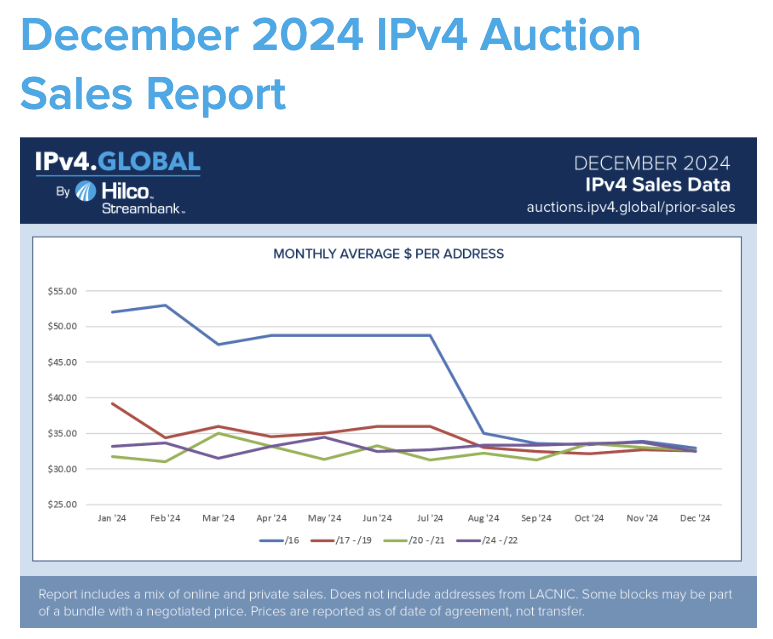
IPv4 address costs
IPv6 trends
- WiFi: One IPv6 /64 subnet per host -> natural user separation on cheap access points
- Datacenter: One IPv6 address per service endpoint:
- No IP + Port tupel anymore
- IPv6 overlay networks with security boundaries
IPv6 History
IPv6 History
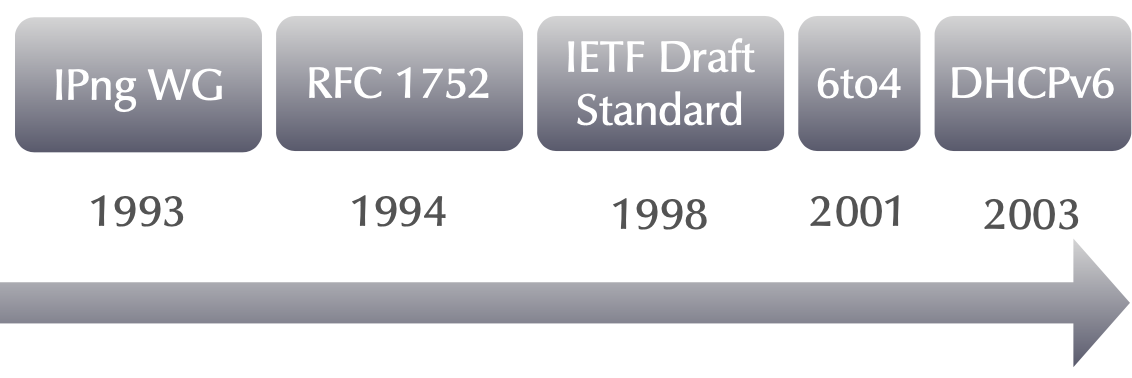
RFC 6540 (April 2012) IPv6 Support Required for All IP-Capable Nodes
- New IP implementations must support IPv6.
- Updates to current IP implementations should support IPv6.
- IPv6 support must be equivalent or better in quality and functionality when compared to IPv4 support in a new or updated IP implementation.
RFC 6540 (April 2012) IPv6 Support Required for All IP-Capable Nodes
- New and updated IP networking implementations should support IPv4 and IPv6 coexistence (dual-stack), but must not require IPv4 for proper and complete function.
- Implementer are encouraged to update existing hardware and software to enable IPv6 wherever technically feasible.
IPv6 Basics
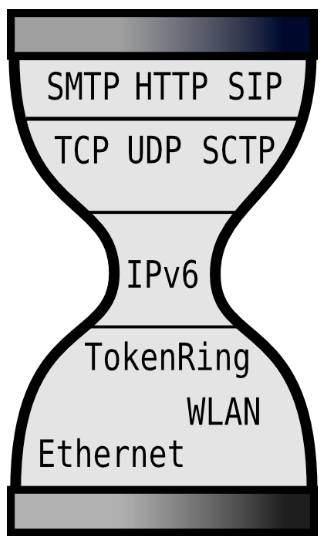
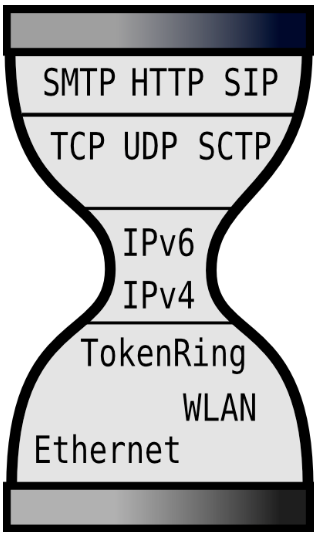
TCP/IP Hourglass
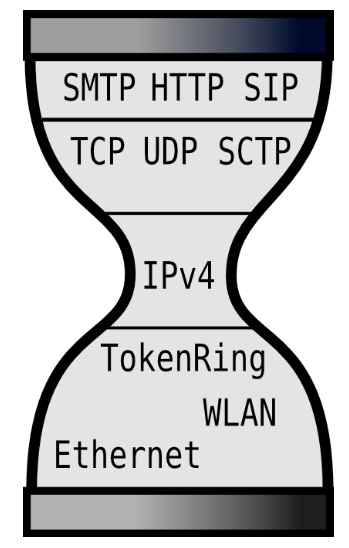
TCP/IP Hourglass for IPv6
TCP/IP Hourglass for Dual-Stack
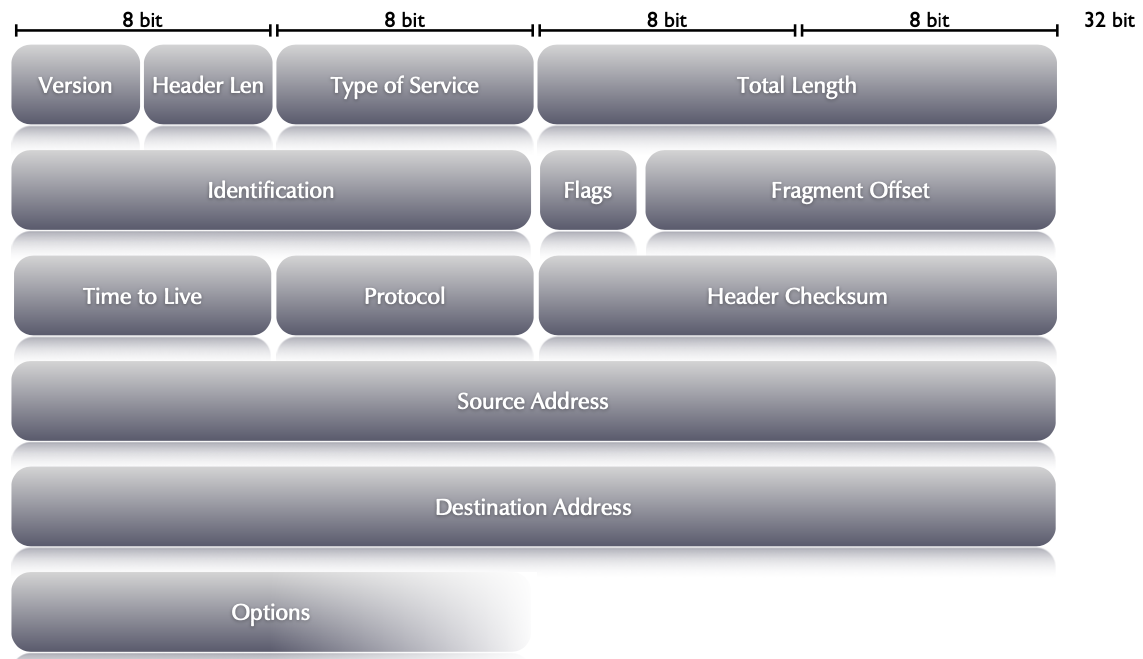
The IPv4 Packet
The IPv6 Packet
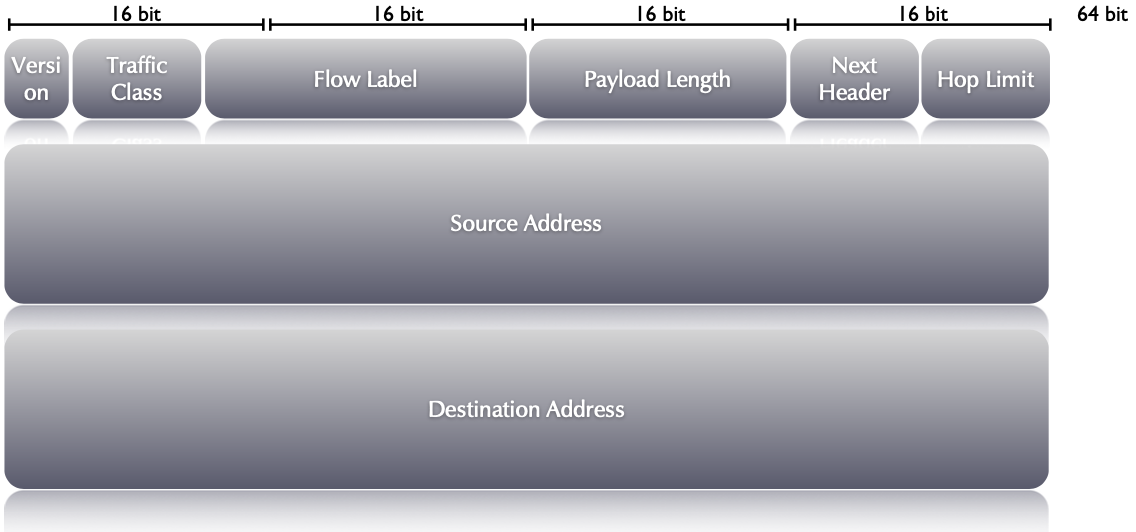
IPv6 Header
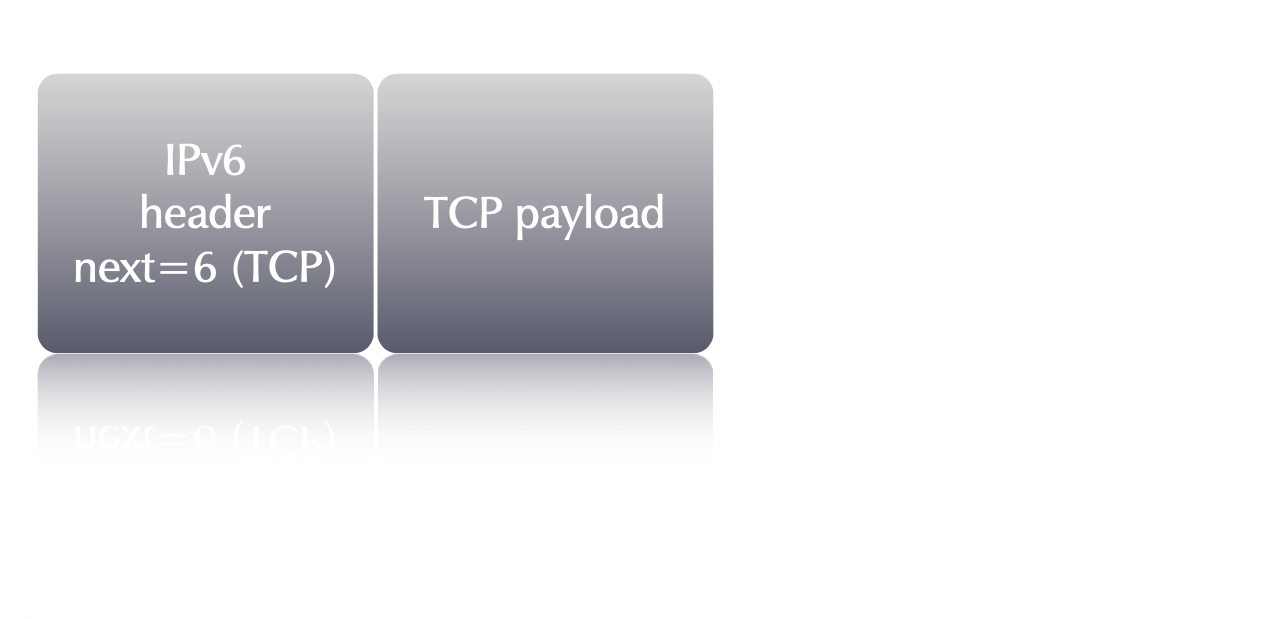
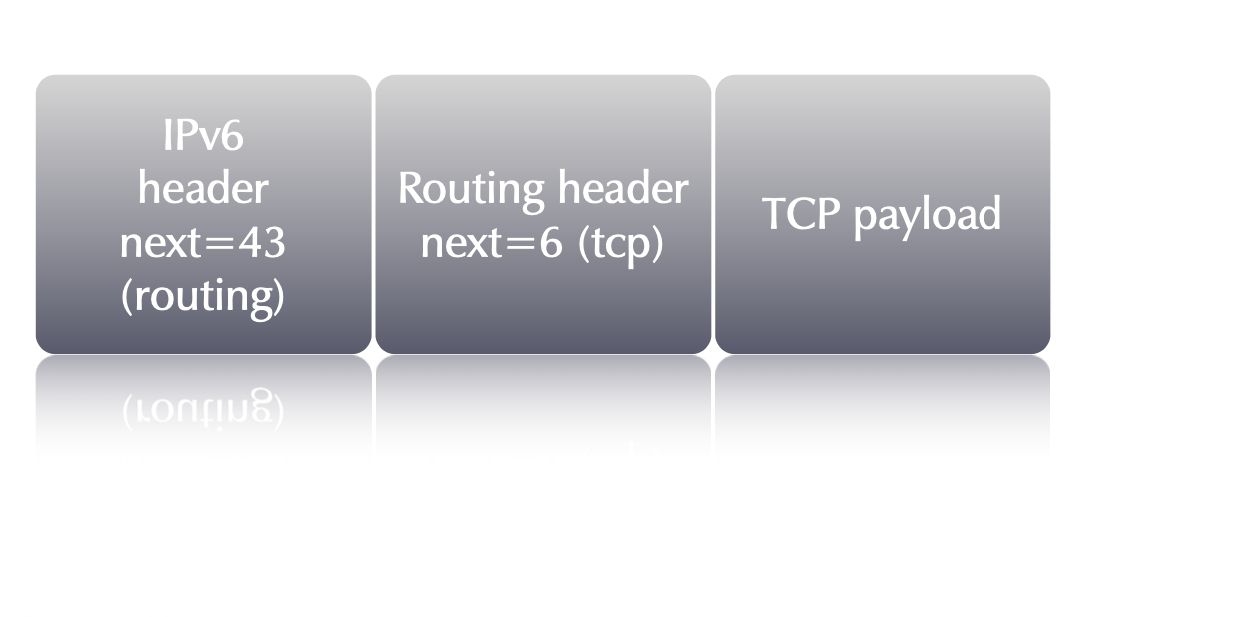
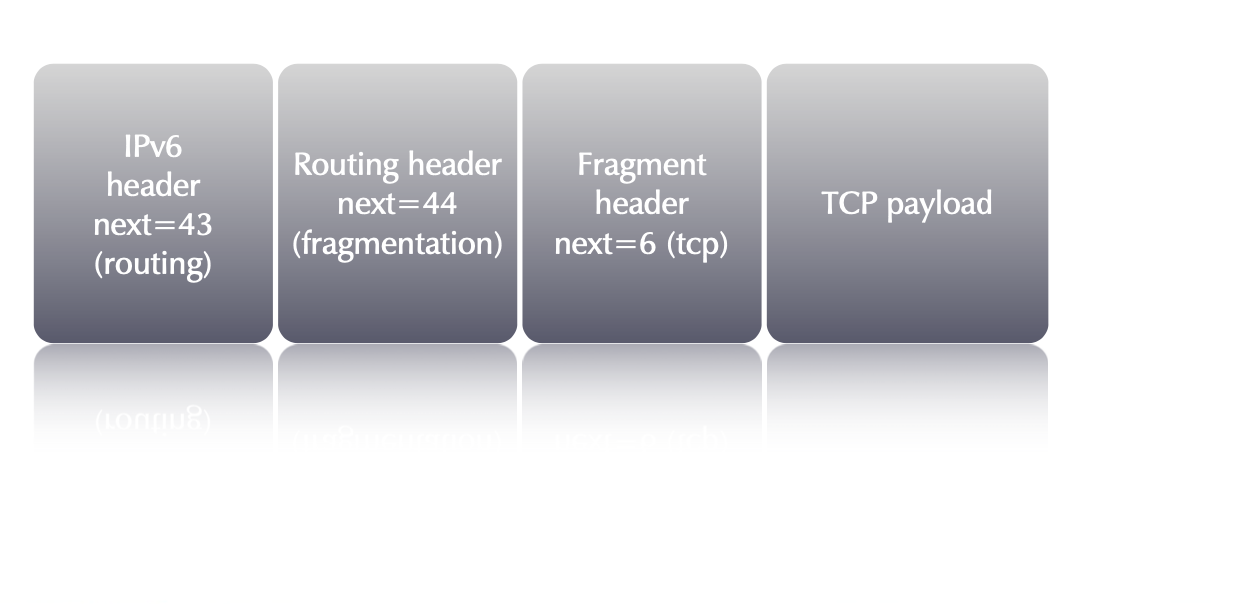
- IPv6 uses extension headers instead of fixed options
- headers are chained one after another
- next header field points to the next extension headers
- or to the upper level protocol
IPv6 Header Example 1
IPv6 Header Example 2
IPv6 Header Example 3
Rules for extension Headers
- The following rules apply to extension headers:
- Each extension header should not appear more than once, with the exception of the Destination Options header.
- The Hop-by-Hop Options header should only appear once.
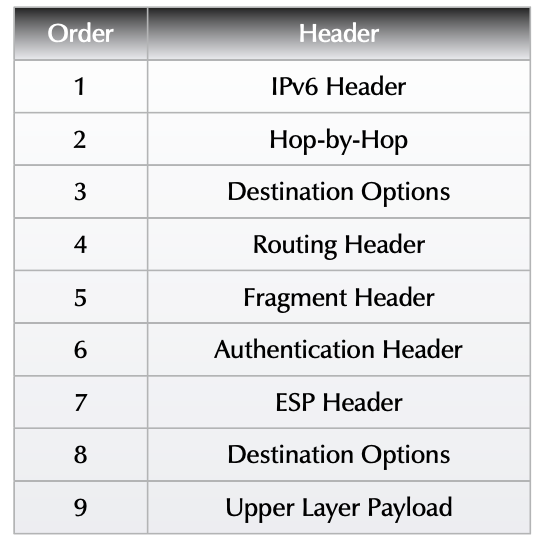
- The Hop-by-Hop Options header should be the first header in the list because it might be examined by every node along the path.
Rules for extension Headers (2)
- The Destination Options header should appear at most twice (before a Routing header and before the upper-layer header).
- The Destination Options header should be the last header in the list, if it is used at all.
- The Fragment header should not appear more than once and should not be combined with the Jumbo Payload Hop-by-Hop option
Rules for extension Headers (3)
- The entire IPv6 header chain must be contained in the first fragment of a packet
- Other than the path MTU constraints, there are no other limits to the number of IPv6 EHs that may be present in a packet
- The only way for a node to obtain the upper-layer protocol type or find the upper-layer protocol header is to parse and process the entire IPv6 header chain, in sequence, starting from the mandatory IPv6 header until the last header in the IPv6 header chain is found
Order of Extension Header
Operational Implications of Extension Headers
- RFC 9098 - Operational Implications of IPv6 Packets with Extension Headers
- Packets with EHs are intentionally dropped in the public Internet in some circumstances
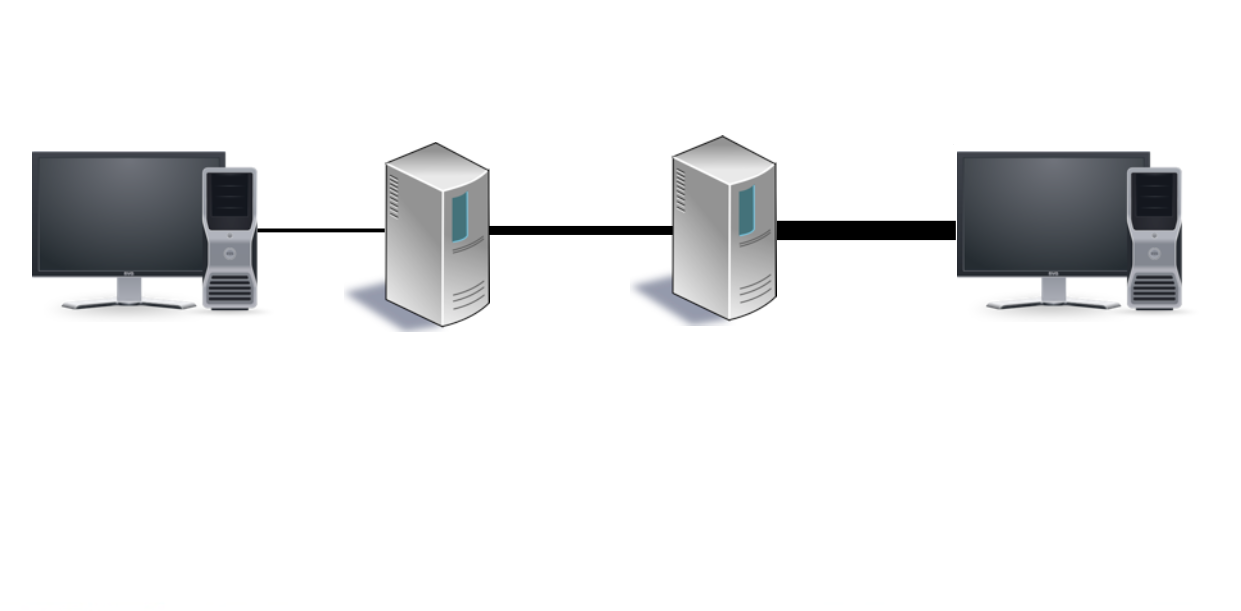
Path MTU Detection (PMTUD)
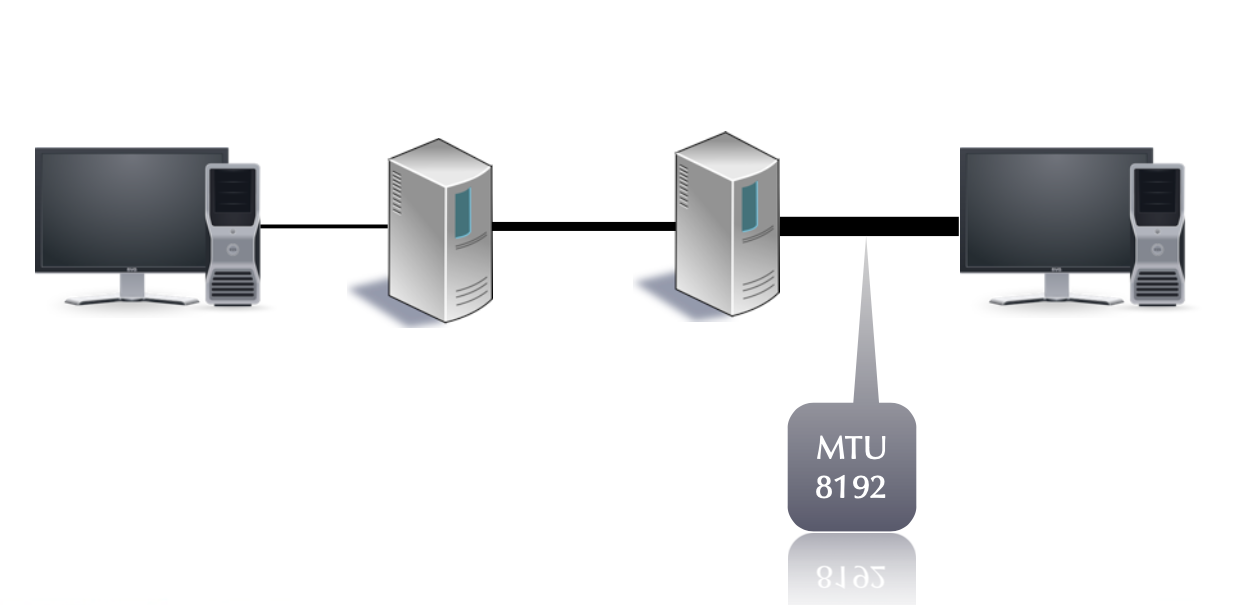
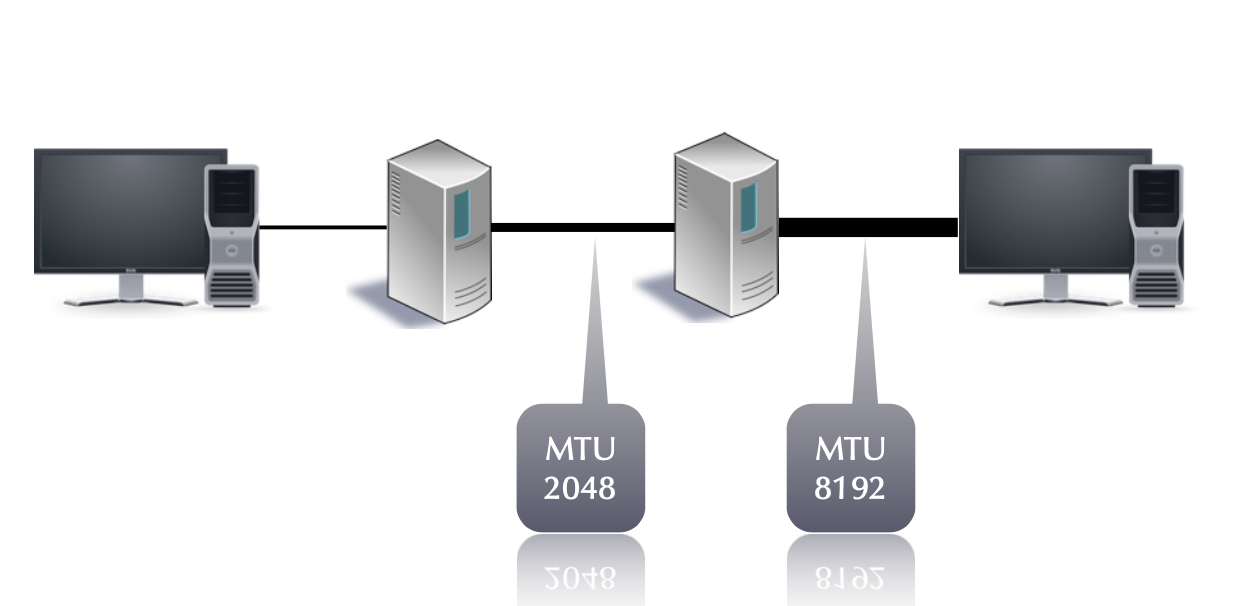
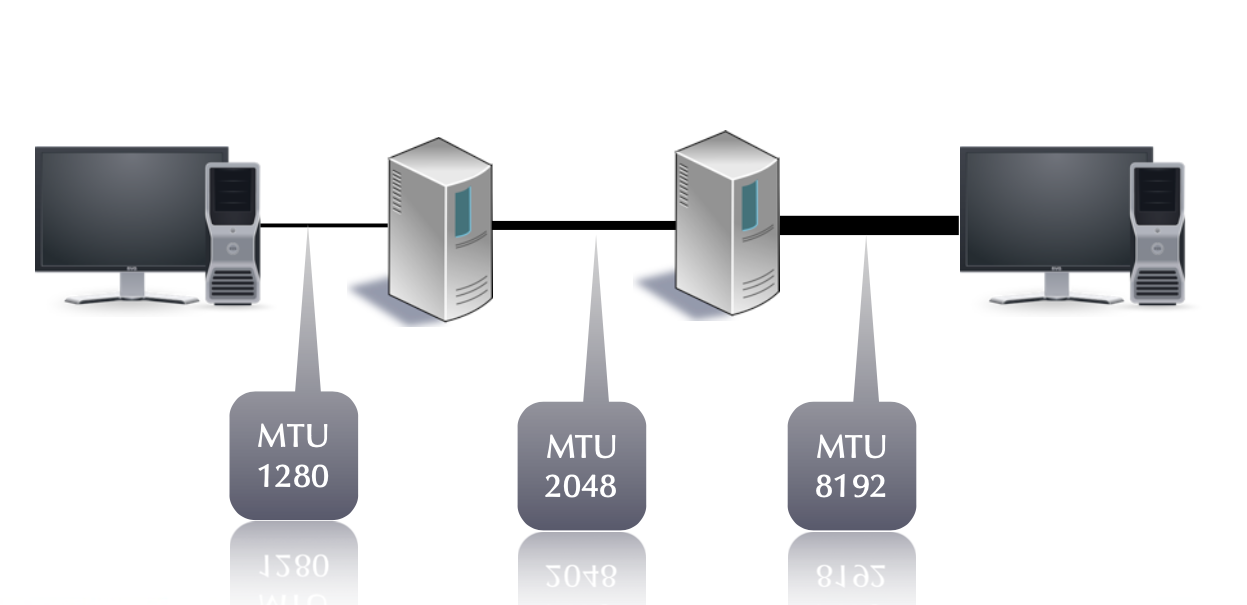
- Path Maximum Transmission Unit Detection
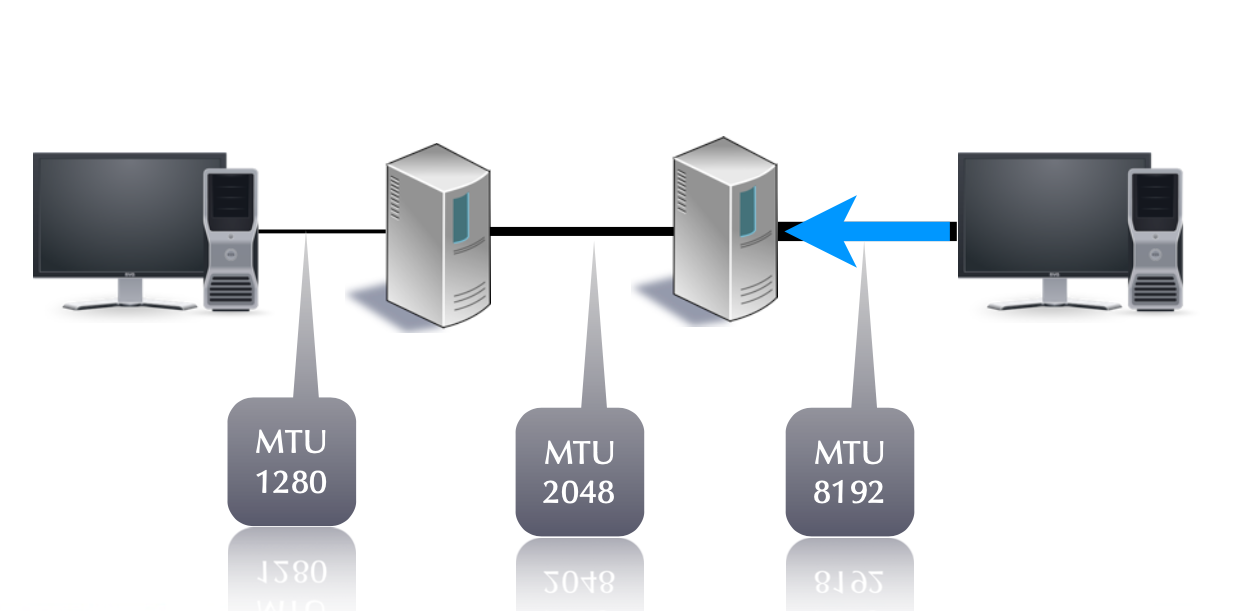
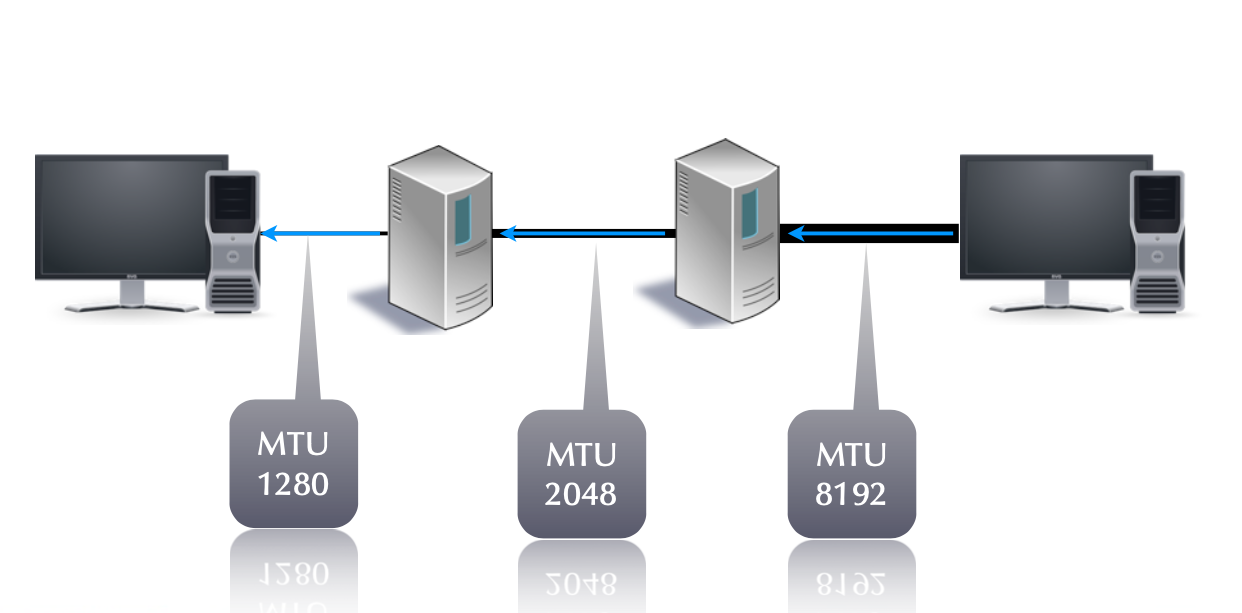
- IPv6 Nodes have a minimum MTU of 1280 byte
- only the sender is allowed to fragment a datagram
Path MTU Detection (PMTUD)
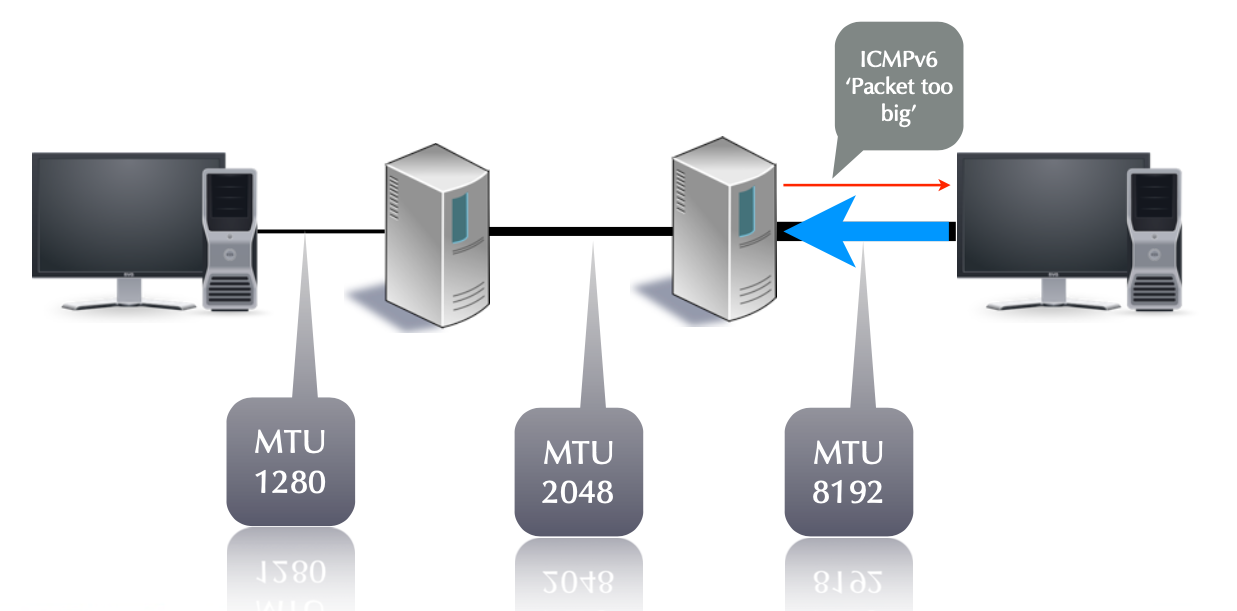
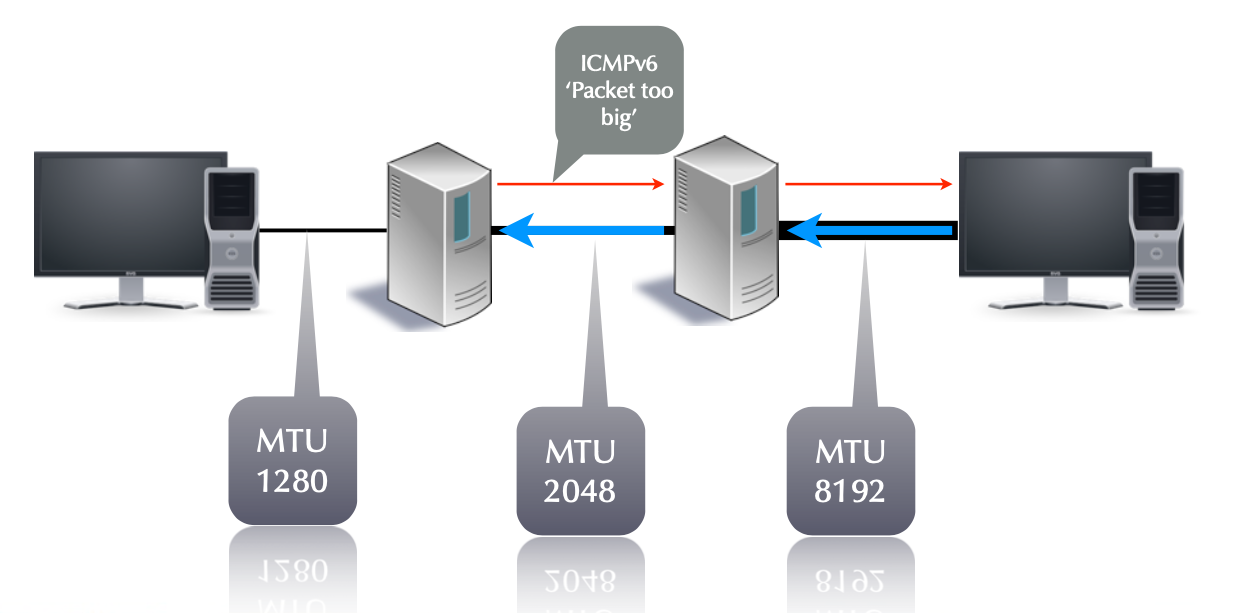
- if a device on the way cannot handle the size of a packet
- it will drop the packet
- and will inform the sender of MTU conflict and the maximum MTU (using ICMPv6 Packet too big message)
- if ICMPv6 Packet too big messages are blocked, IPv6 is broken!
PMTUD (1)
PMTUD (2)
PMTUD (3)
PMTUD (4)
PMTUD (5)
PMTUD (6)
PMTUD (7)
PMTUD (8)
IPv6 Addresses
IPv6 Addresses
- IPv6 Addresses are 128bit long (16 bytes)
- IPv4 had 32bit per Address
- per Bit, the Address space doubles
- IPv6 has 2^128 Addresses (340 billion billion billion billion or 3.4 × 10^38 or 340 undecillion)
IPv6 Address Format
- IPv6 Addresses are written using 32 hexadecimal digits
- the digits are arranged in 8 groups of four digits, separated by colon
: - the display rules for IPv6 addresses have been redefined in RFC 5952
- the digits are arranged in 8 groups of four digits, separated by colon
IPv6 Address Format
- A full IPv6 Address:
2001:0db8:1c01:0029:021a:5f4f:fe9a:5aab
IPv6 Address Abbreviations
- leading zeros of every group of 4 hex-digits can be omitted:
2001:0db8:1c01:0029:021a:5f4f:fe9a:5aab→2001:db8:1c01:29:21a:5f4f:fe9a:5aab
IPv6 Address Abbreviations
- one sequence of all zero groups can be replaced by a pair of
colons:
2001:db8:100:0:0:0:541:fa20→2001:db8:100::541:fa20
IPv6 Address Abbreviations
- IPv6 Address Prefixes:
2001:db8:100::/642001:db8::/322002::/16
- The Prefix defines the number of important bits in this network from the start
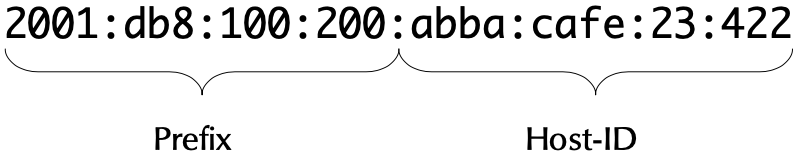
IPv6 prefix and host-id
- Prefix and Host-ID
Types of IPv6 Addresses
- Unicast (one to one communication)
- Multicast (one to many communication)
- Anycast (one to some communication)
Types of IPv6 Unicast Addresses
- Global Unicast Addresses (usable in the whole Internet)
- Link-Local Addresses (only valid in a single subnet)
- Site-Local Addresses (deprecated, originally for a site)
- Unique-Local Addresses (like private IP addresses, but statistically unique)
- Special Addresses (see next slide)
- Transition Addresses (IPv4 to IPv6 Transition Protocols)
IPv6 Special Addresses
- Unspecified Address (all zeros):
:: - Loopback Address:
::1
Global Unicast Addresses
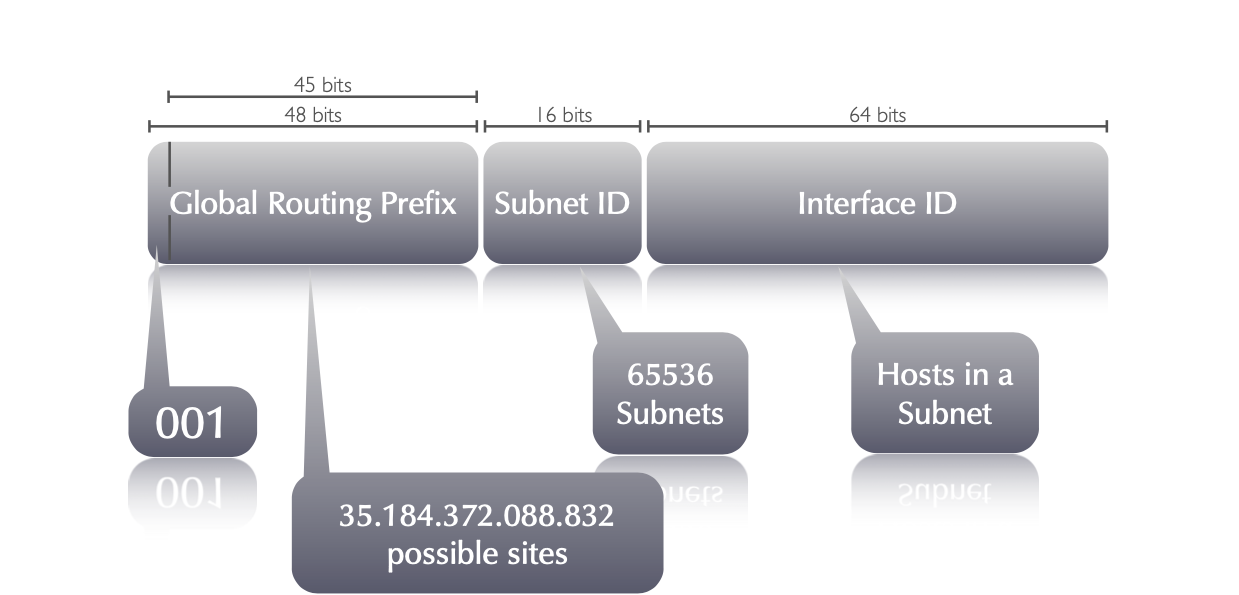
IPv6 Interface ID
- The Interface ID can be build from
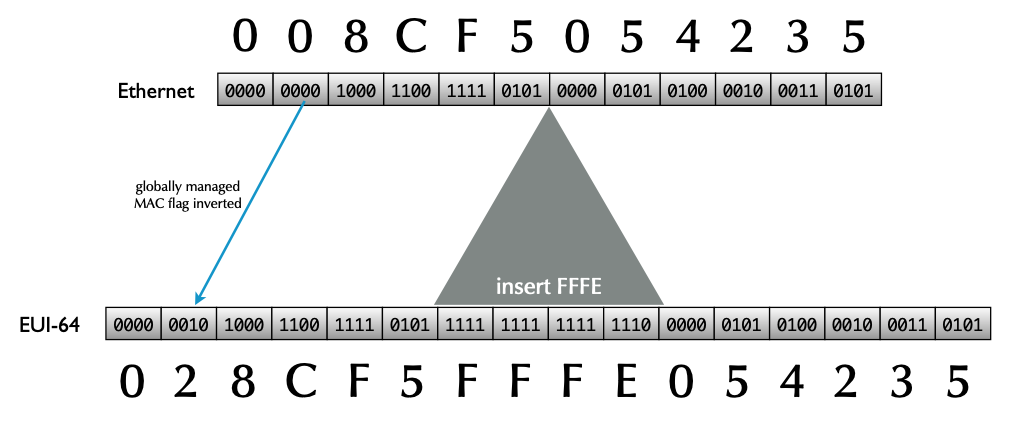
- an Interface EUI-64 ID (7th bit inverted, used for stable addresses on server machines)
- MAC Address (48bit) (7th bit inverted and 0xfffe inserted after 3rd byte of the MAC address)
- based on the network (stable only for a single network)
- random (privacy)
- manual
MAC-Address to Interface ID
Link-Local-Addresses
Link-Local-Addresses
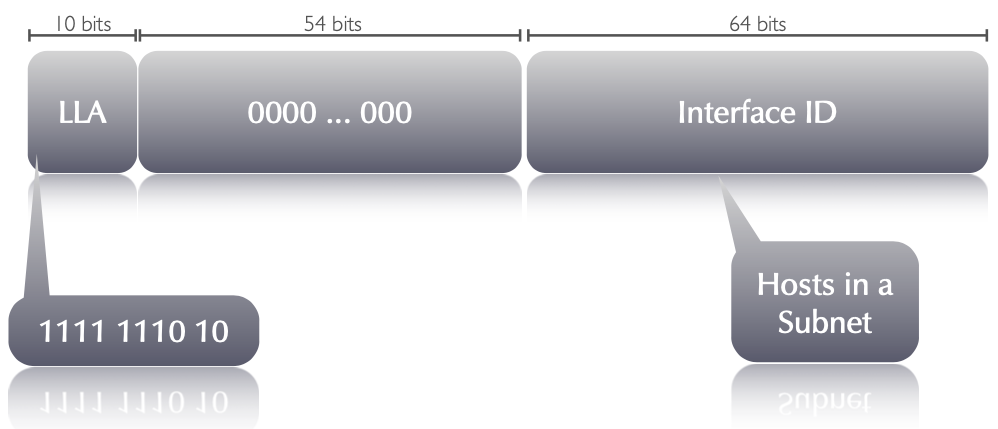
- Link-Local addresses are used for communication of hosts on a single link
- link-local addresses are always configured if IPv6 is enabled
- used for Neighborhood Discovery and local communication
Link-Local-Addresses
- Prefix for Link-Local Addresses is
fe80::/10- IPv6 router never forward link-local addresses
- similar to IPv4 APIPA (automatic private IP addressing,
169.254.0.0/16)
Zone IDs
- Link-Local addresses can be reused on every link
- a machine with more that one link can reach different machines with the same link-local IPv6 address
Zone IDs
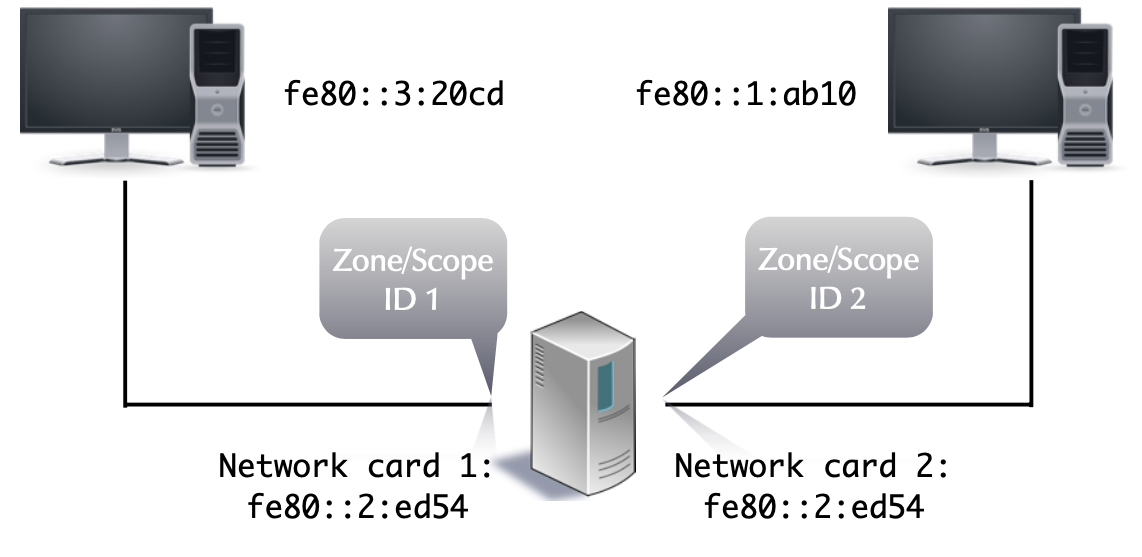
Zone/Scope ID
en1: flags=8863<UP,BROADCAST,SMART,RUNNING,SIMPLEX,MULTICAST> mtu 1500
    inet6 fe80::226:bbff:fe05:fa4f%en1 prefixlen 64 scopeid 0x5
    inet 10.122.104.112 netmask 0xffffff80 broadcast 10.122.104.127
    ether 00:26:bb:05:fa:4f
    media: autoselect status: active
    supported media: autoselect
Unique-Local-Addresses
Unique-Local-Addresses
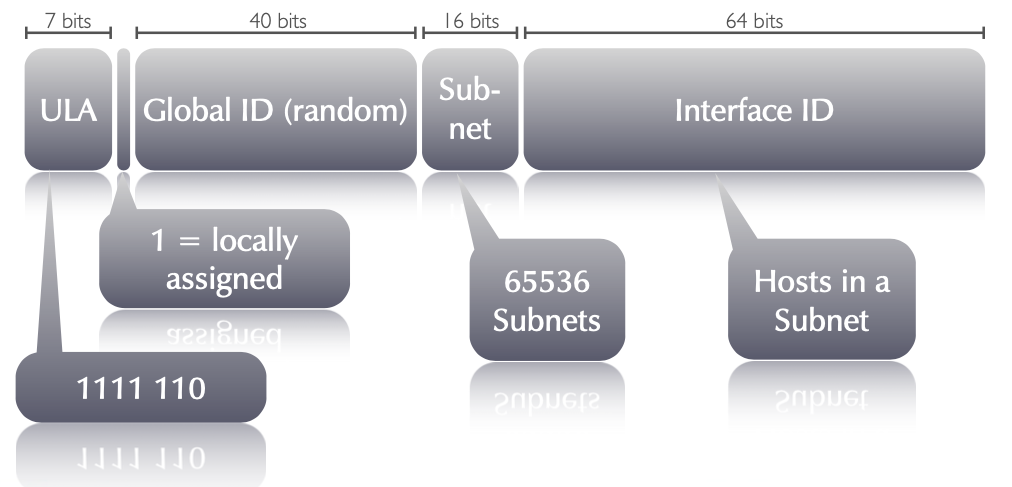
- Unique local addresses are private to an organization, yet statistically unique
- low probability of address clashes if two sites with ULA merge
- the
Lflag indicates local assignment (default)
- ULA Addresses have the prefix
fd00::/8- ULAs have a global scope (not scope/zone ID) •will not be routed in the Internet
Multicast Addresses
Multicast Addresses
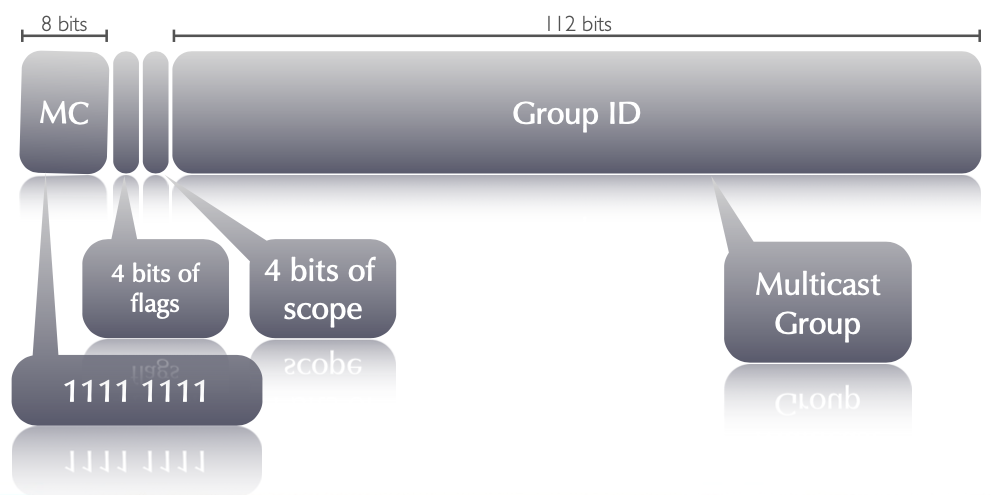
- multicast addresses always starts with
ff- IPv6 uses multicast for internal services
- no broadcasts anymore, only multicast!
Multicast Address Flags
| Bit | usage |
|---|---|
| 0 | Transient Flag: 0 = permanent address (IANA assigned, well-known) 1 = transient address |
| 1 | Prefix flag (RFC 3306) |
| 2 | Rendezvous Point (RFC 3956) |
| 3 | undefined |
Multicast Address Scope
| Hex-Value | Scope |
|---|---|
| 1 | Interface local |
| 2 | Link-Local |
| 4 | Admin-Local |
| 5 | Site-Local |
| 8 | Organization Local |
| E | Global |
Node Local Scope
| address | usage |
|---|---|
| ff01::1 | all nodes address |
| ff01::2 | all routers address |
| ff01::fb | mDNSv6 |
Link-Local Scope
| address | usage |
|---|---|
| ff02::1 | all nodes address |
| ff02::2 | all routers address |
| ff02::fb | mDNSv6 |
| ff02::f | UPnP Devices |
| ff02::1:1 | Link Name |
| ff02::1:2 | all DHCP agents |
| ff02::1:3 | LLMNR |
| ff02::101 | network time protocol (ntp) |
| ff02::1:ffXX:XXXX | Solicited-Node Address |
| ff02:0:0:0:0:2:ff00::/104 | Node Information Queries RFC 4620 |
Site-Local/Variable Scope
| address | usage |
|---|---|
| ff05::2 | all routers address |
| ff05::fb | mDNSv6 |
| ff05::1:3 | all DHCPv6 Servers |
| ff0x::101 | network time protocol (NTP) |
Solicited-Node Address
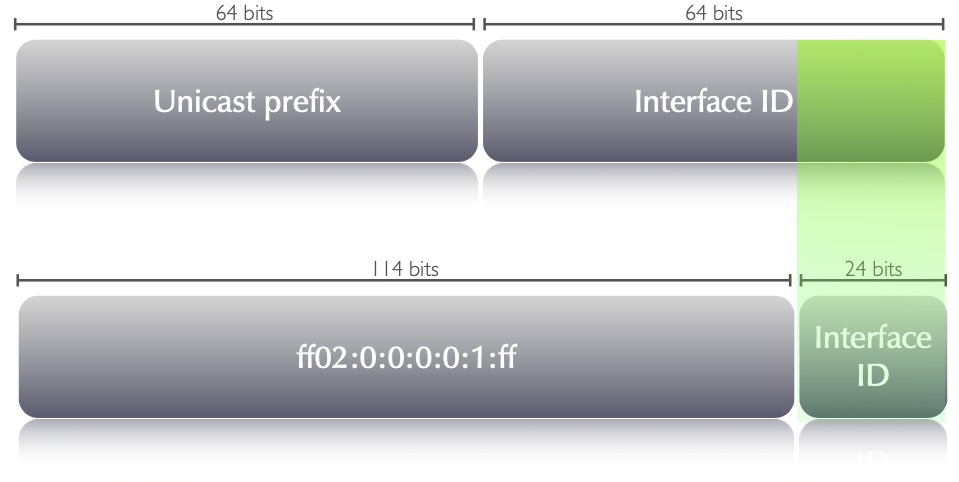
- the Solicited node address is used for link-layer address resolution
- was ARP in IPv4
- the solicited-node multicast address is build from the prefix
ff02::1:ff00:0/104and the last 24 bits of the unicast IPv6 address to be resolved
Solicited-Node Address
Transition Addresses
- IPv4 compatible Addresses
0:0:0:0:0:0:w.x.y.z(::w.x.y.z)- deprecated by RFC4291
- IPv4 mapped Addresses
0:0:0:0:0:ffff:w.x.y.z(::ffff:w.x.y.z)
Transition Addresses
- 6to4 Addresses:
2002:WWXX:YYZZ:<subnetid>:<interfaceID> - ISATAP Addresses
<64bitprefix>:0:5efe:w.x.y.z
special Addresses
Questions?