IPv6 Transition and NAT
Building Bridges
Carsten Strotmann
Created: 2025-01-30 Thu 09:43
IPv6 Address Translation (NAT)
IPv6 NAT
- IPv4 Network Address Translation (Cone-NAT) has broken the Internet "end-to-end" connectivity paradigm
- "end-to-end" communication allows more resilient, decentralized networks
- IPv6 aims to re-establish "end-to-end" communication between hosts
IPv6 NAT
- For various reasons, network address translation might still be required in IPv6
- For IPv4 to IPv6 transition technologies
- For policy reasons
- For network topology reasons
NAT and IPv6
- IPv6 tries to avoid NAT (Network Address Translation) if possible
- NAT has many negative side effects on Internet protocols
- Sometimes, NAT can be useful even with IPv6
- But be careful - NAT should be an exception in IPv6
- See RFC 5902 (Informal) "IAB Thoughts on IPv6 Network Address Translation"
NAT and IPv6
- Use cases for IPv6 NAT:
- Avoiding renumbering
- Facilitating multihoming
- Making configurations homogeneous
- Hiding internal network details
- Providing simple security
NAT and IPv6
- RFC 6052 "IPv6 Addressing of IPv4/IPv6 Translators" (Standards Track) defines a well known IPv6 prefix for (IPv6 to IPv4) address translation:
64:ff9b::/96- This prefix is checksum neutral.
- The sum of the hexadecimal numbers
0064andff9bisffff, i.e., a value equal to zero in one's complement arithmetic. - An IPv4-embedded IPv6 address constructed with this prefix will have the same one's complement checksum as the embedded IPv4 address.
IPv6 NAT
- We will cover
- MAP - Mapping of Address and Port
- IPv6-to-IPv6 Network Prefix Translation
- 464XLAT
- NAT64/DNS64
- DS-Lite/lightweight DS-Lite
- Carrier Grade NAT (CGN) / challenges with CGN NAT
- deprecated IPv6 NAT technologies
Network Prefix Translation
Network Prefix Translation
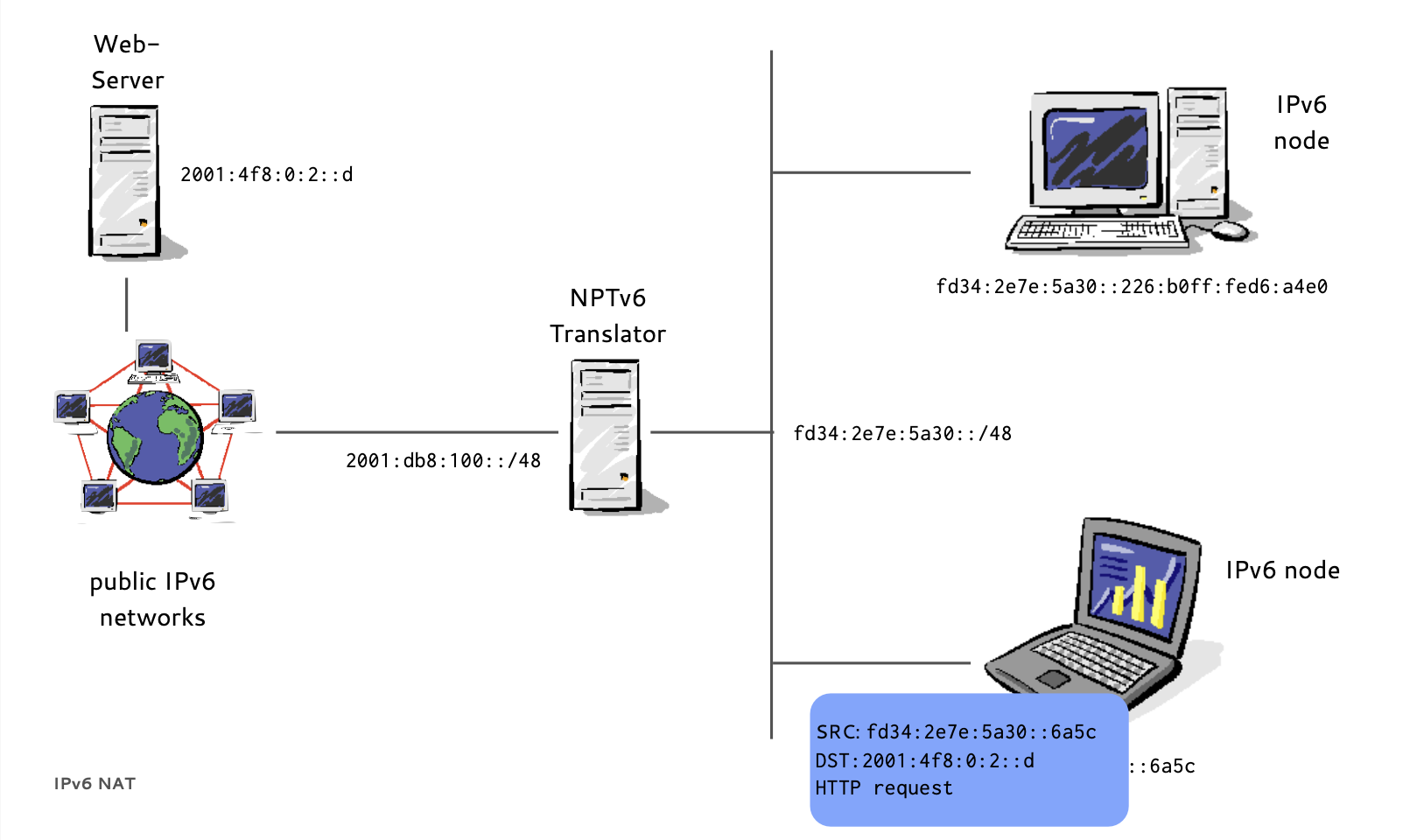
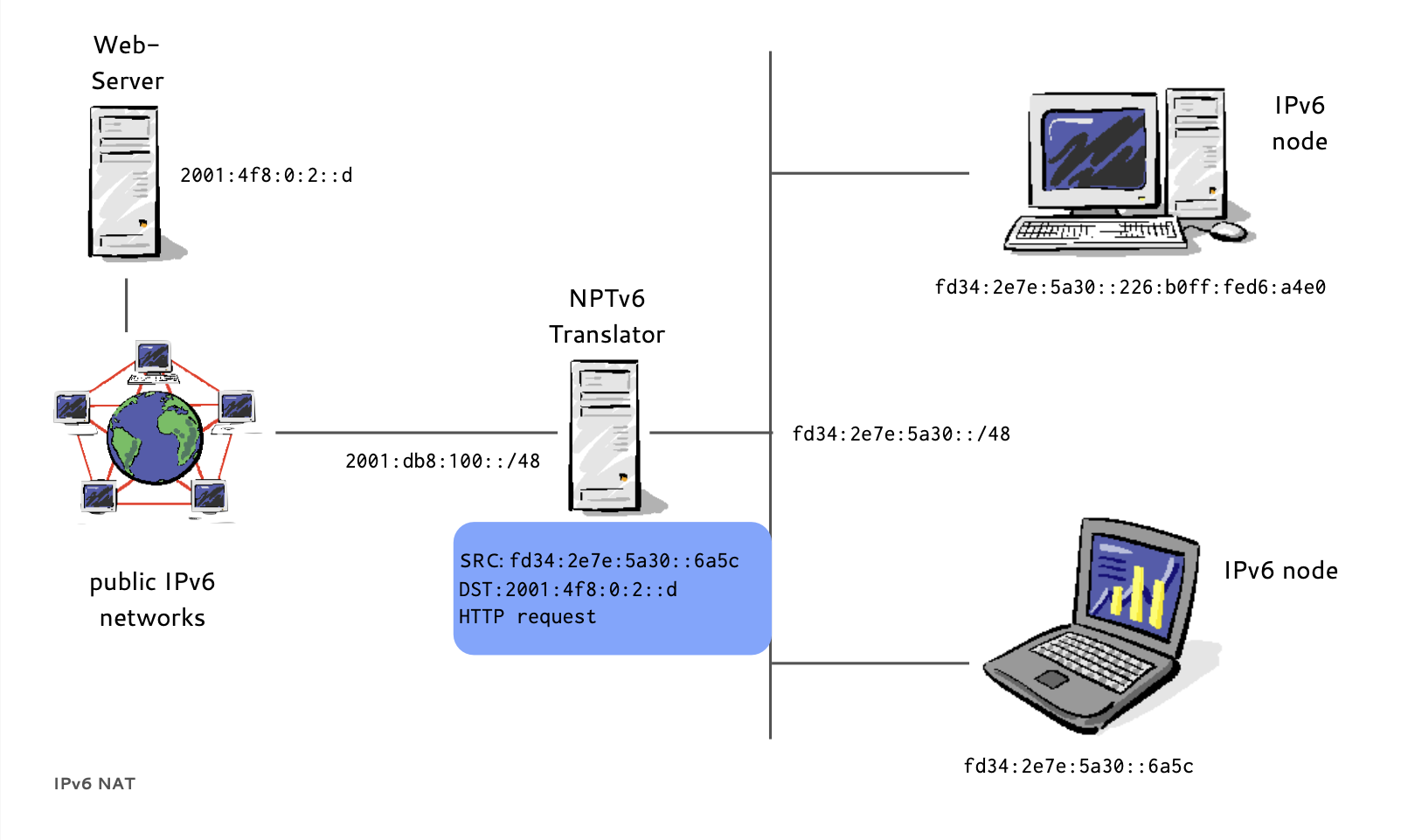
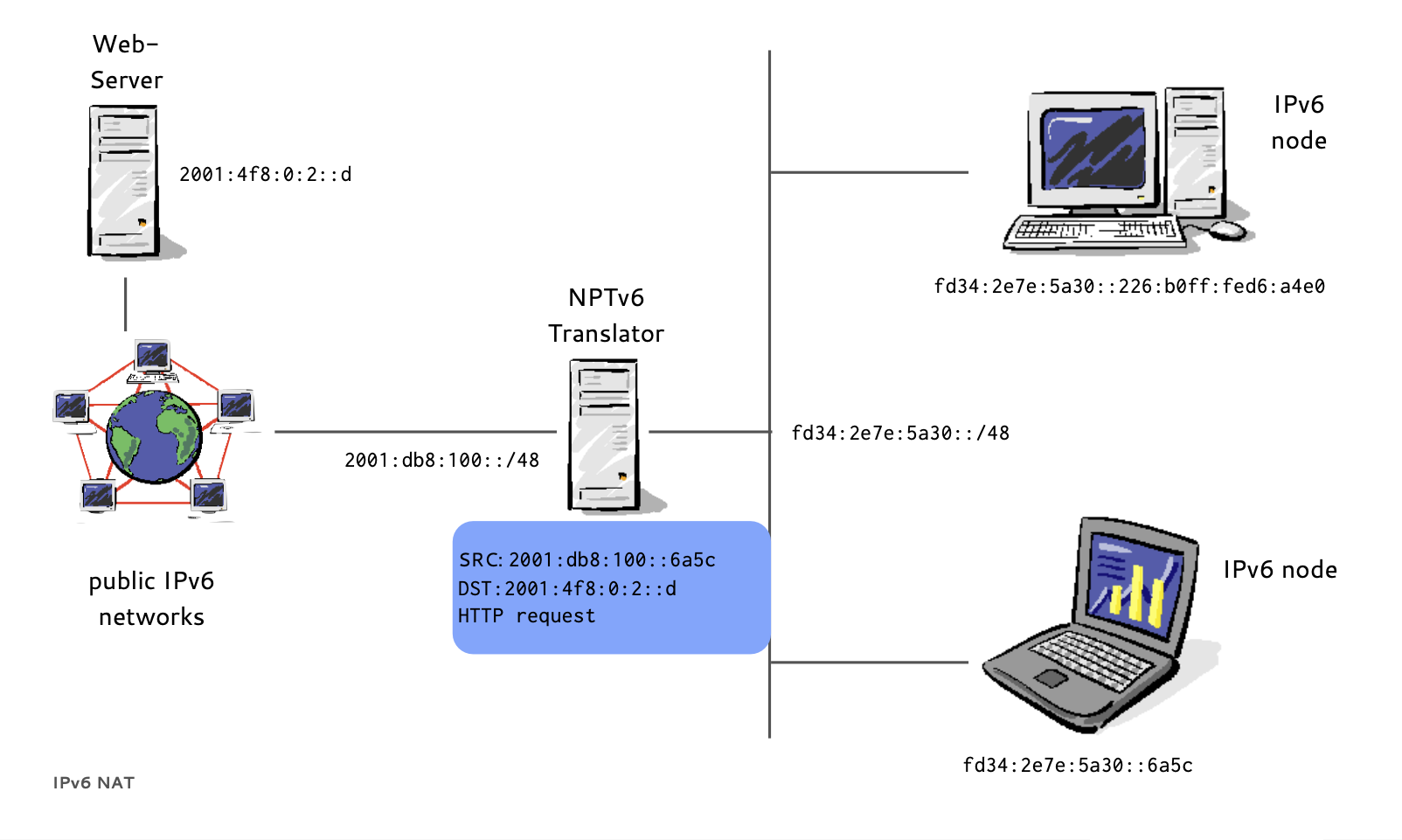
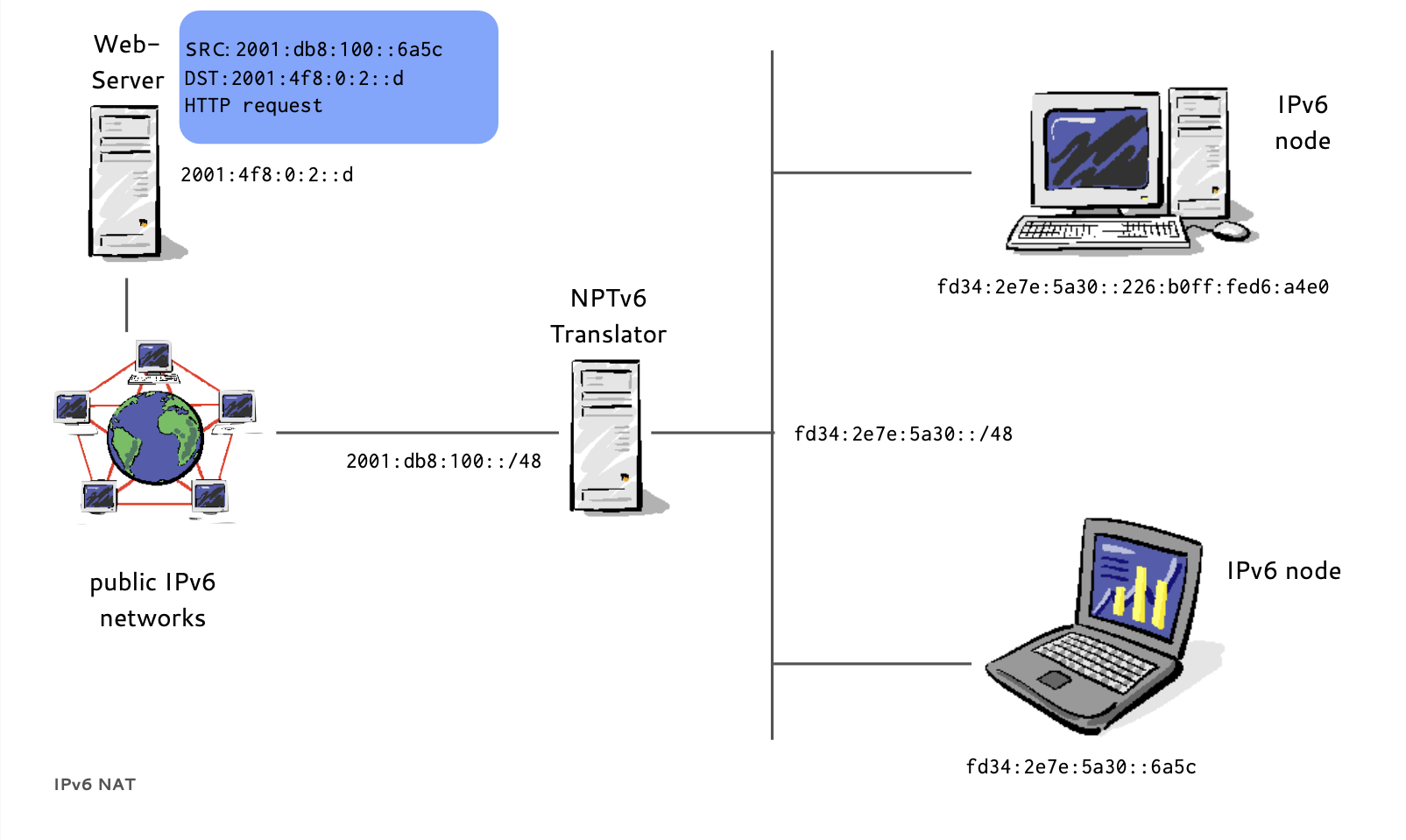
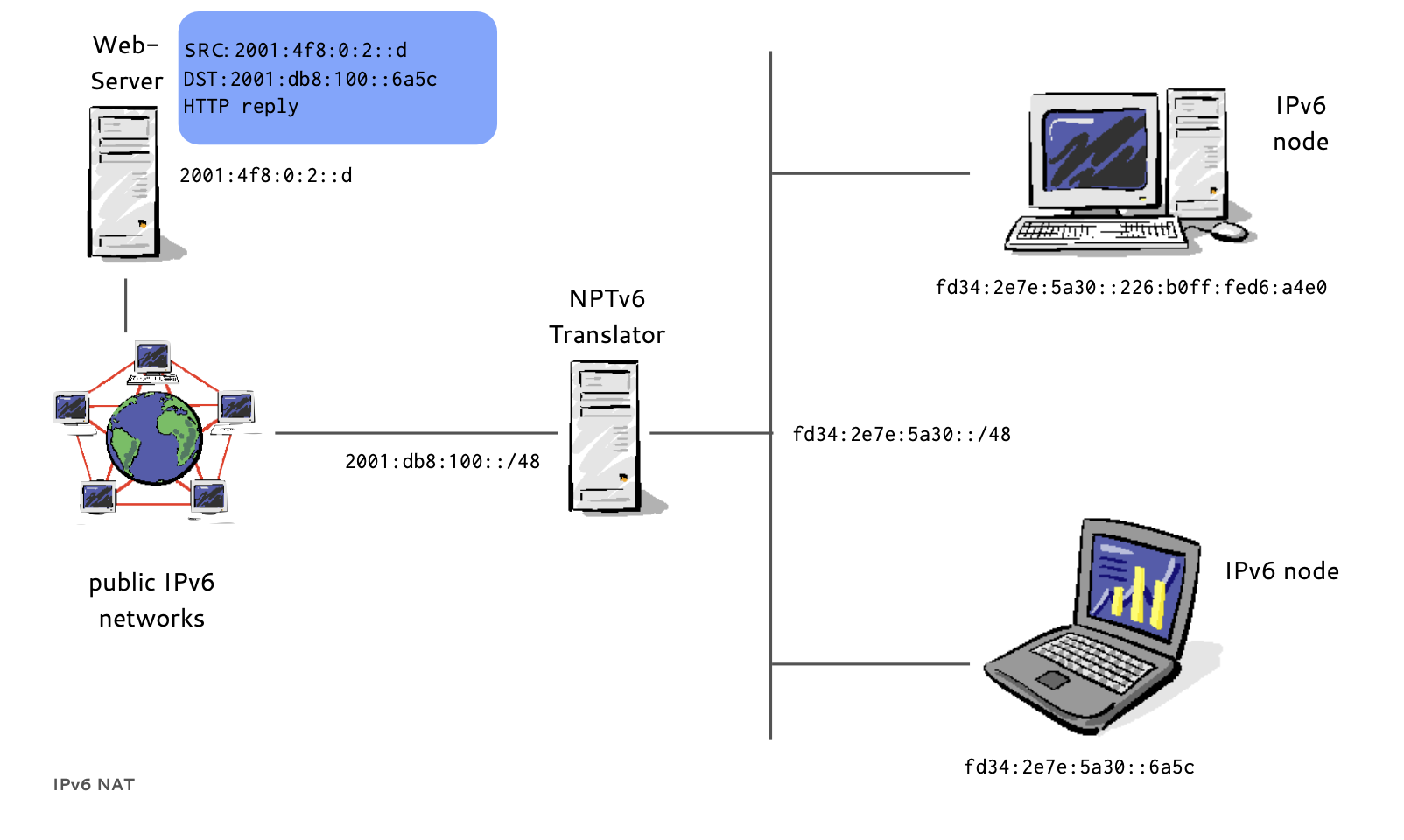
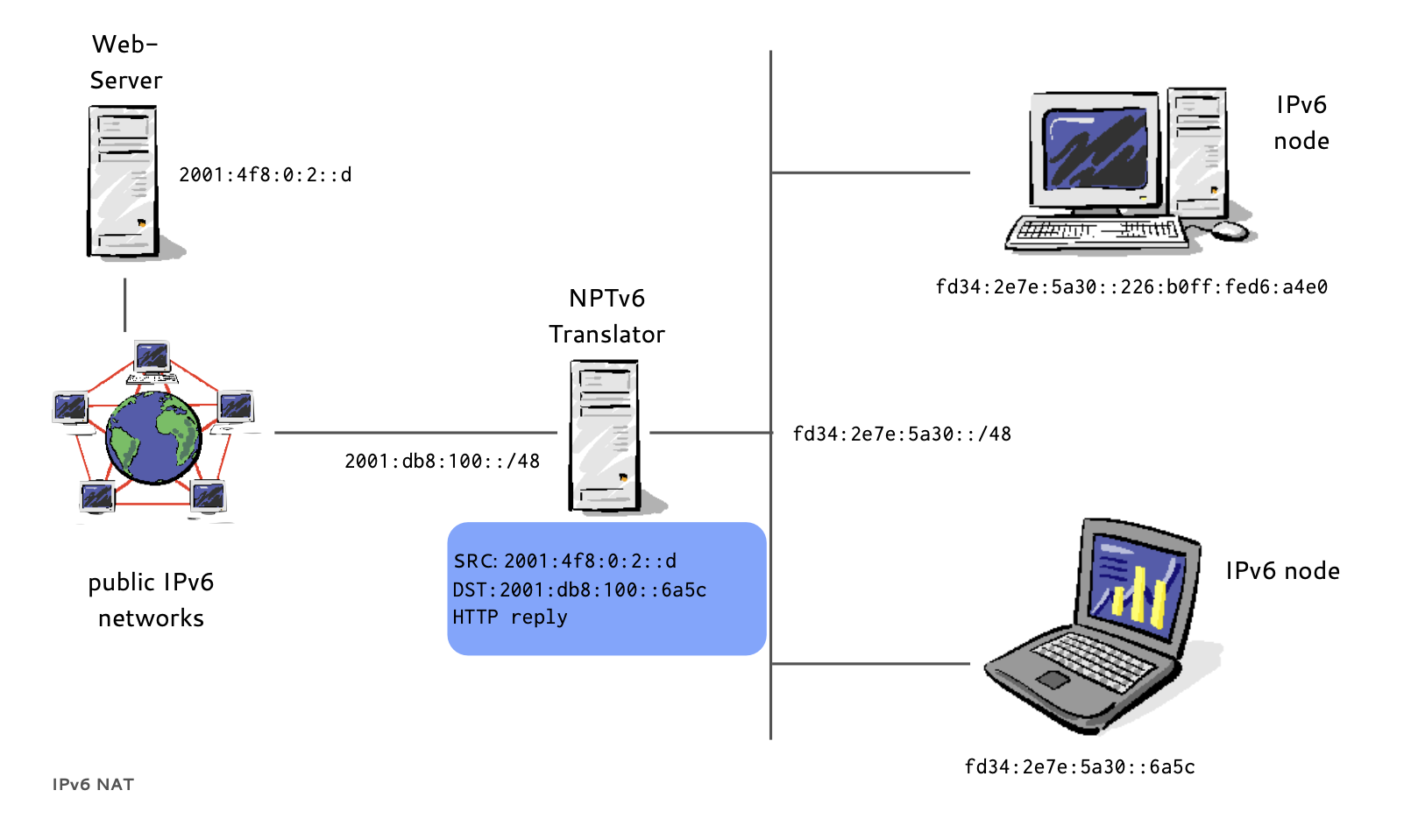
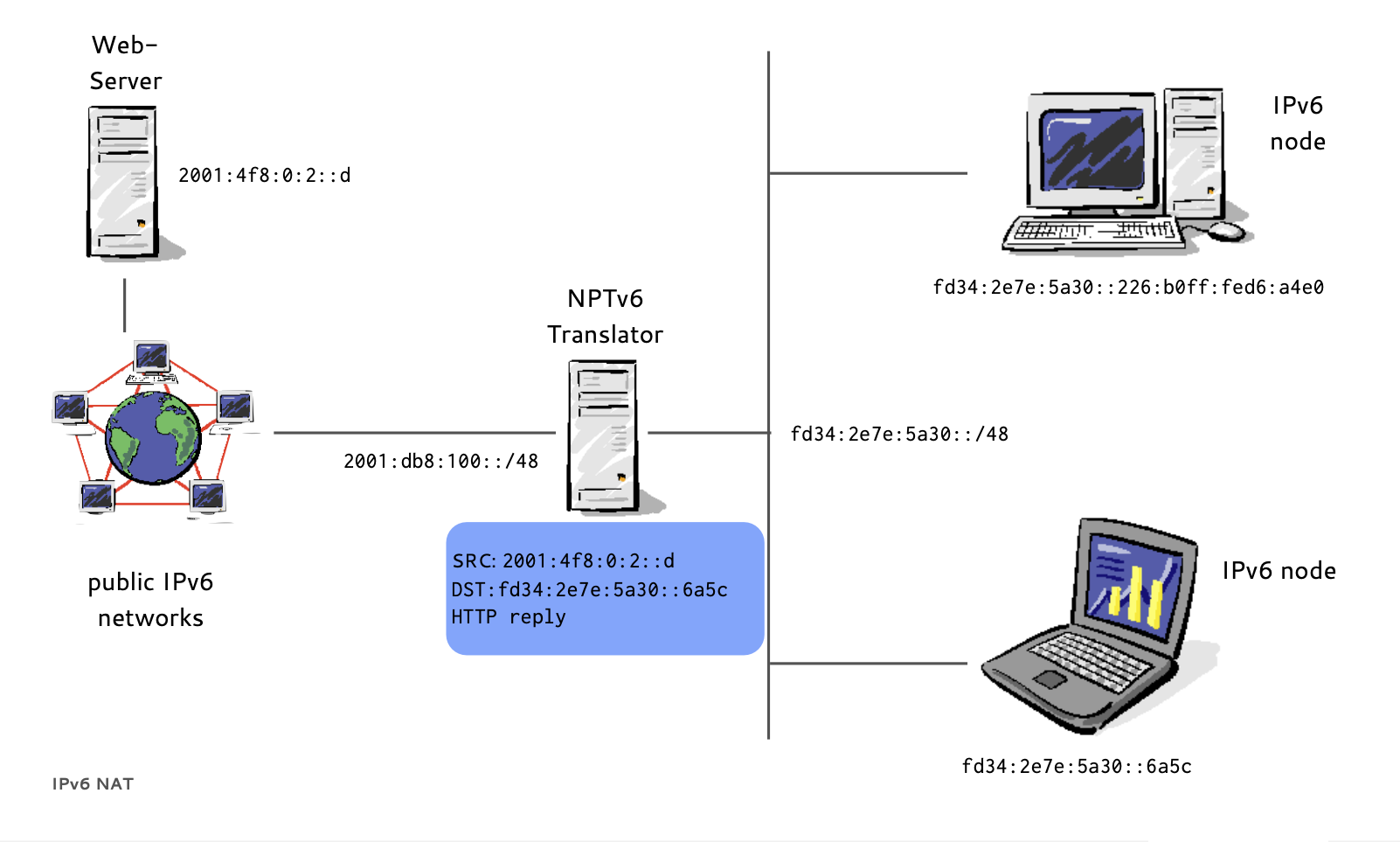
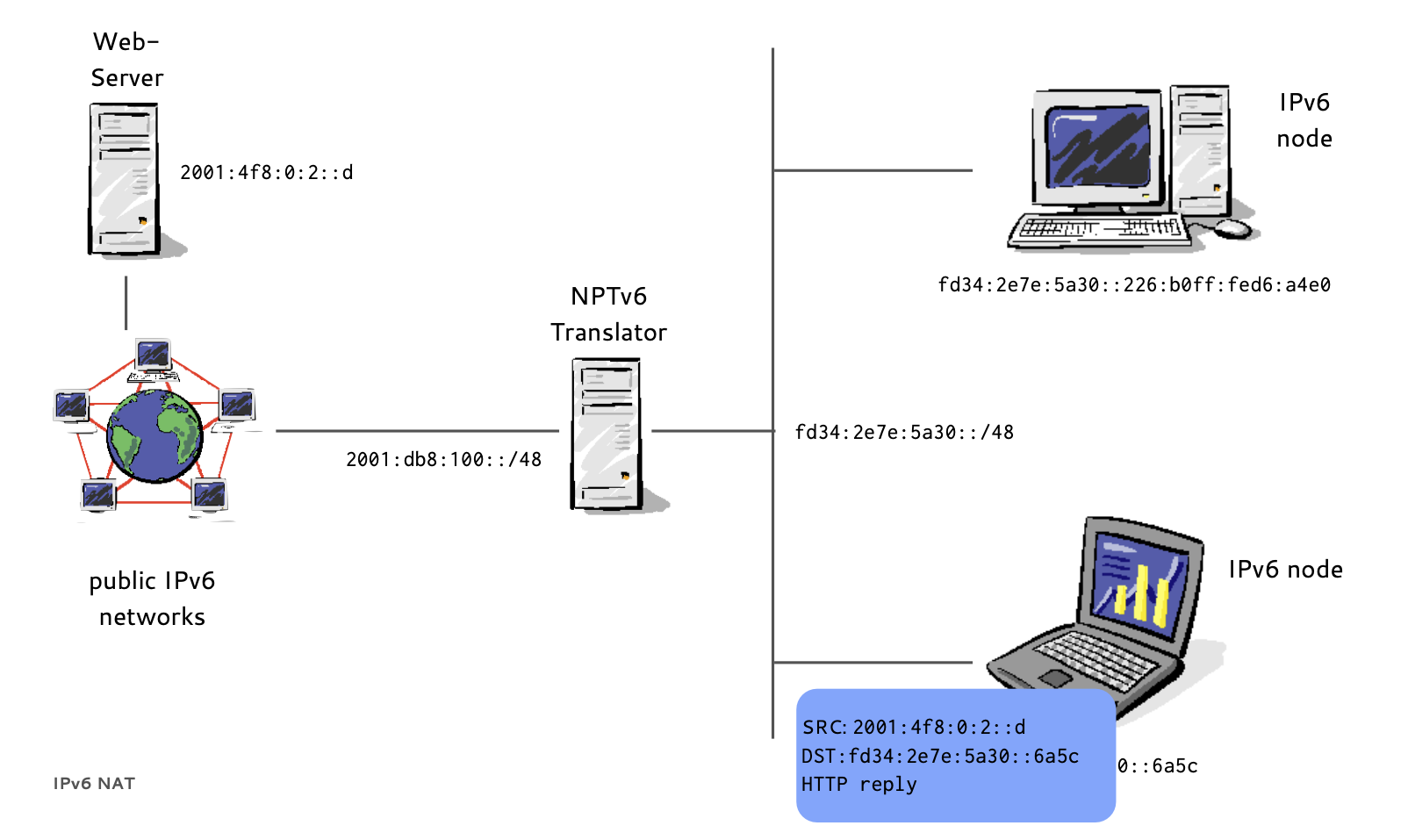
- RFC 6296 "IPv6-to-IPv6 Network Prefix Translation" (experimental) defines NPTv6
- End-to-end reachability is preserved, the prefix is translated, the interface-id is kept
- Firewalls are required to control the flow of traffic
- Prefix translators do not store or need to share state, multiple independent translators possible
- Translation is 1:1 at the network layer, there is no need to modify port numbers or other transport parameters (but IP addresses in upper layer protocols create issues)
IPv6 NPT (1/8)
IPv6 NPT (2/8)
IPv6 NPT (3/8)
IPv6 NPT (4/8)
IPv6 NPT (5/8)
IPv6 NPT (6/8)
IPv6 NPT (7/8)
IPv6 NPT (8/8)
IPv6 Network Prefix Translation
- NPTv6 is available for
- Linux ip6tables / nftables
- xBSD "pf" Firewall
- Commercial Router OS (Juniper JunOS …)
- Alternatives to NPTv6 are documented in RFC 7157 "IPv6 Multihoming without Network Address Translation"
464XLAT
464XLAT - IPv4 over IPv6-only networks
- 464XLAT is defined in RFC 6877 - 464XLAT: Combination of Stateful and Stateless Translation (Informational)
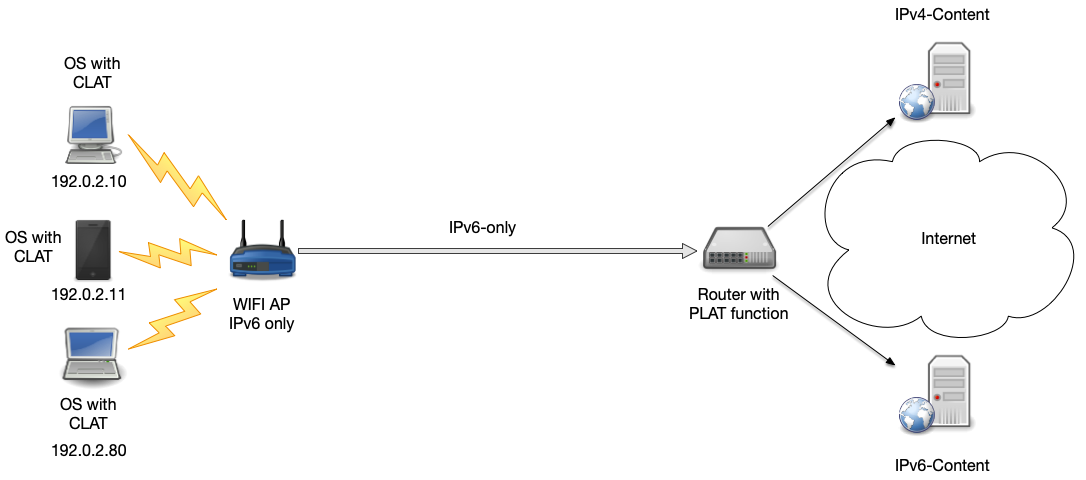
- 464XLAT "tunnels" IPv4 traffic over IPv6-only networks between CLAT and PLAT (more on these in a bit)
- 464XLAT has been originally invented for mobile carrier networks, but has seen popularity in other types on networks (enterprise networks) in the last years
464XLAT - CLAT and PLAT
- In 464XLAT, the CLAT encapsulates the IPv4 address into an IPv6 address, the IPv6 prefix is routed towards the PLAT
- CLAT: client/customer side translator. Can be a separate box, but is usually build into an operating systems network stack (Android, iOS, macOS, Linux)
- The CLAT is stateless
464XLAT - CLAT and PLAT
- The encapsulated traffic is send over IPv6 towards the PLAT
- PLAT: provider translator
- The PLAT has IPv4 connectivity and creates a new IPv4 packet from the encapsulated IPv4 address
- The PLAT needs to keep state (like a traditional NAT44 device)
- The PLAT is located at the edge of the IPv6-only network (despite the name, it does not need to be operated by a "provider")
464XLAT
464XLAT operation
NAT64/DNS64
NAT64/DNS64
- NAT64/DNS64 builds on the functions for IPv4/IPv6 translation as seen before
- It uses a special DNS function (DNS64) to translate between IPv4 and IPv6 addresses
DNS64 / NAT64
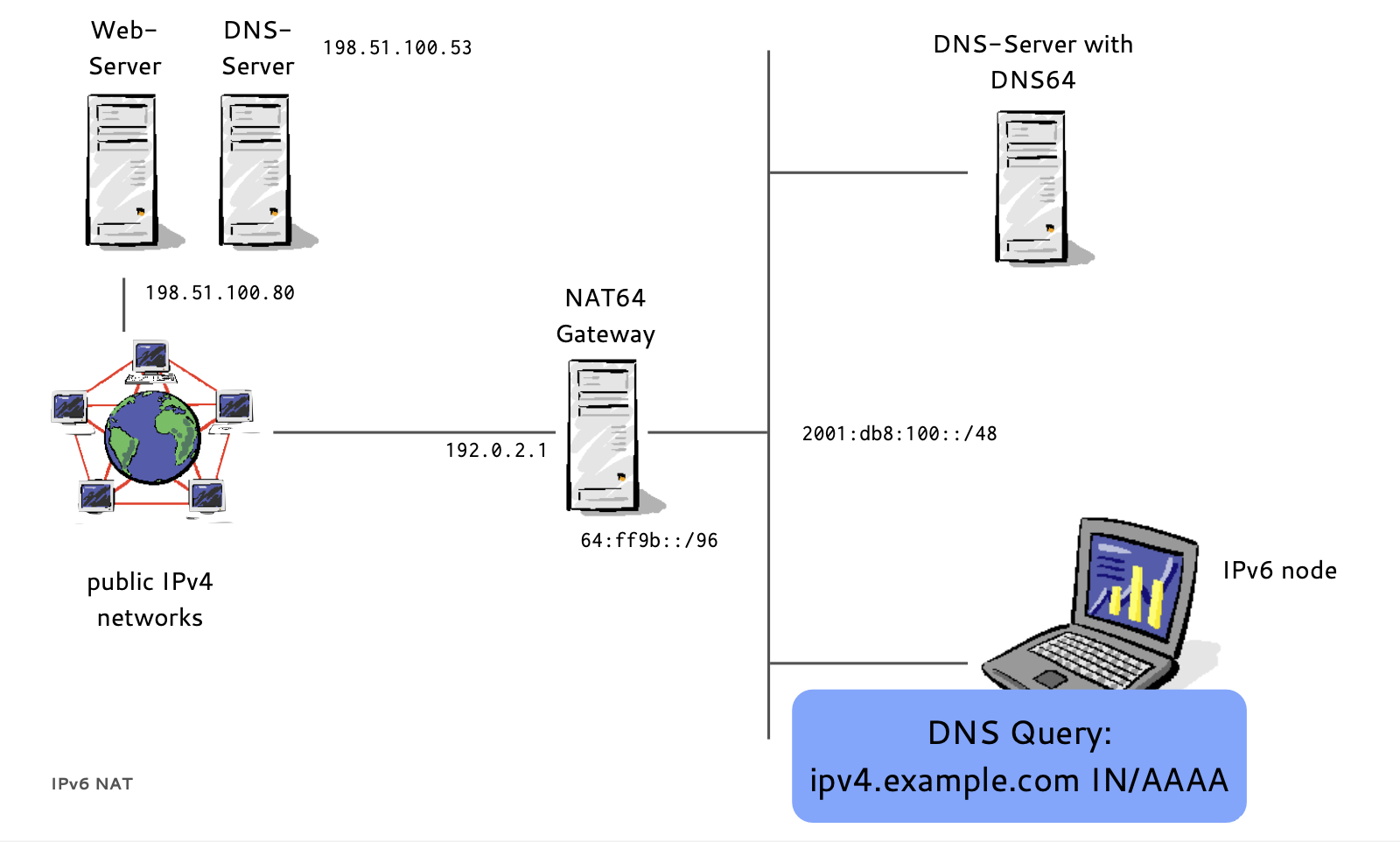
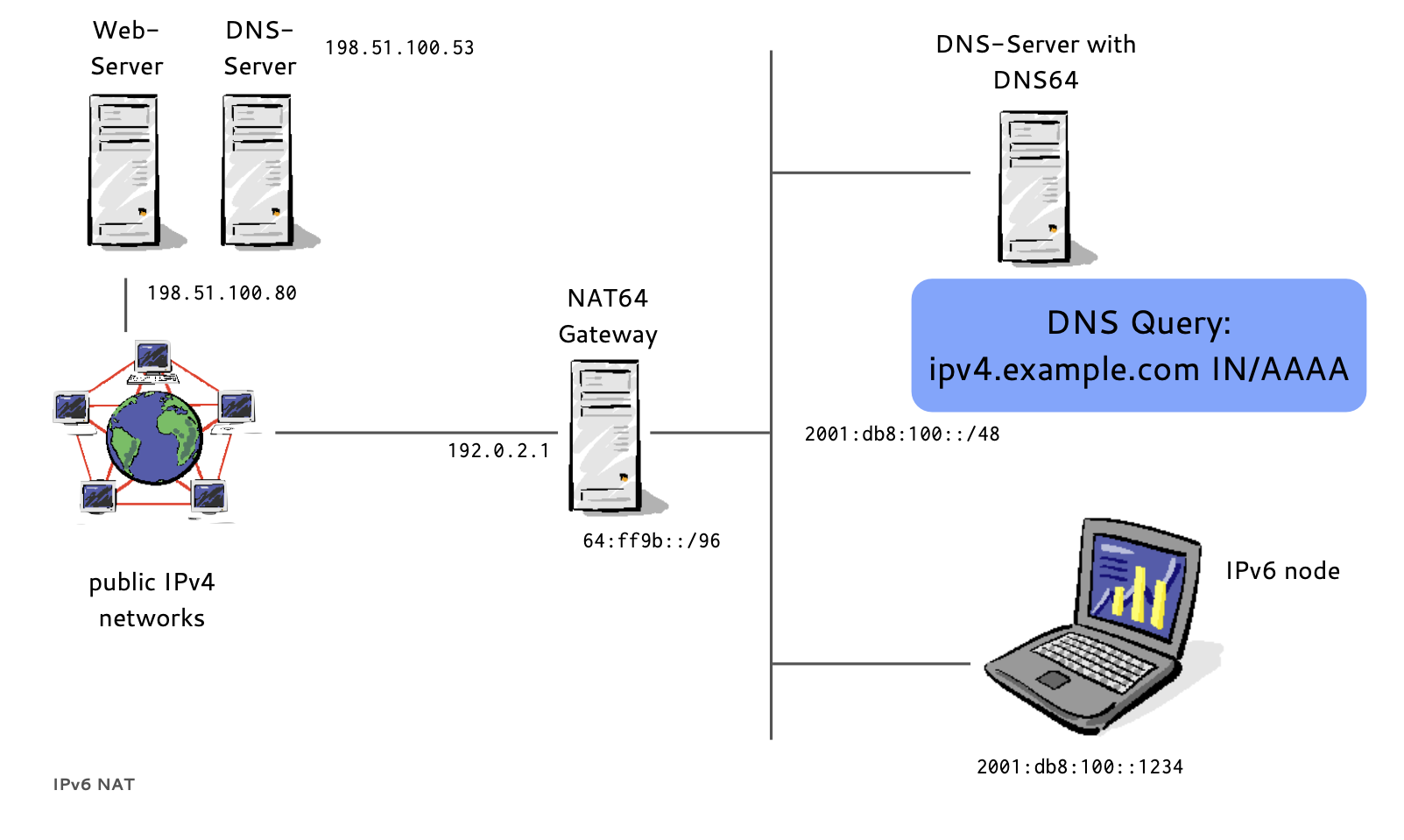
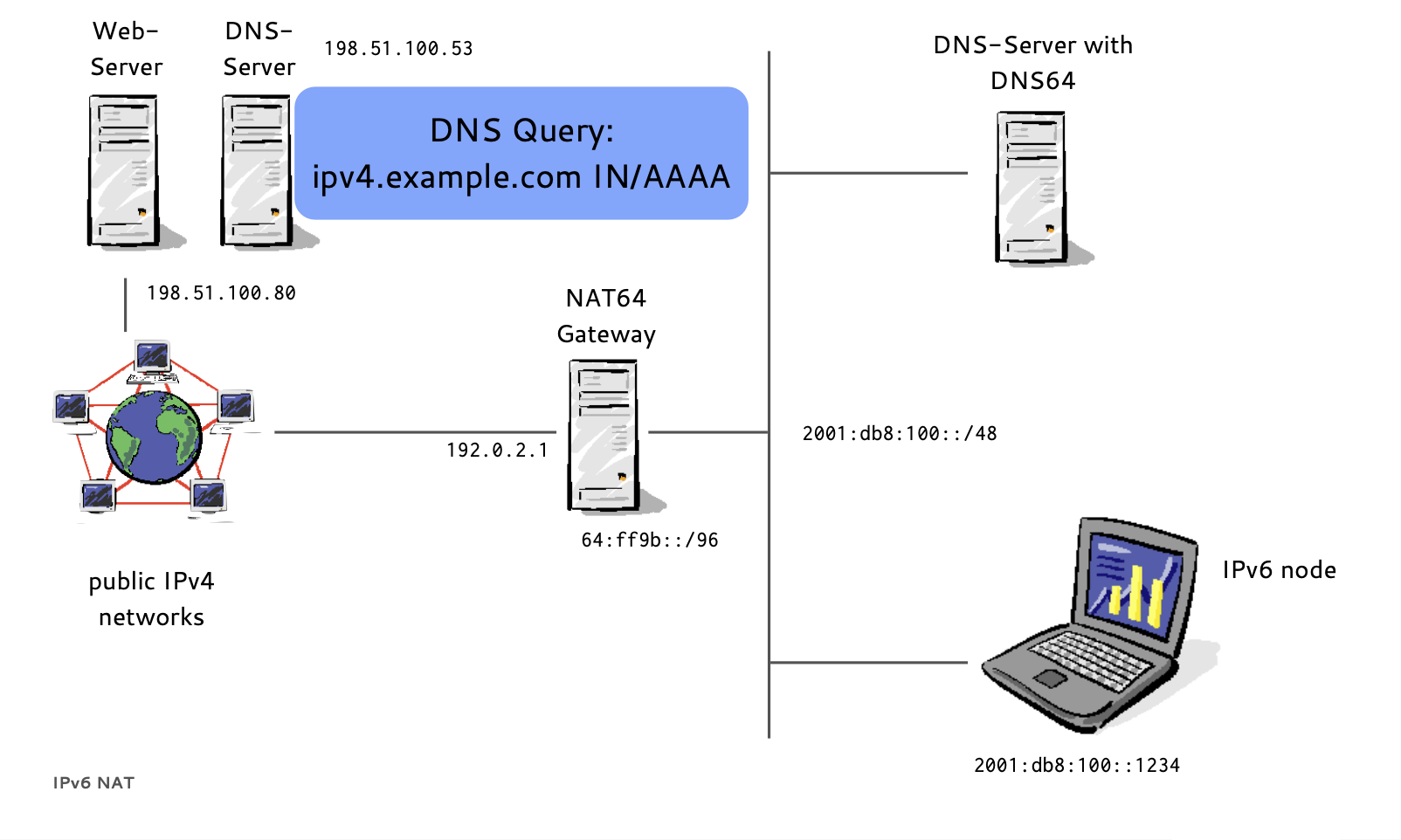
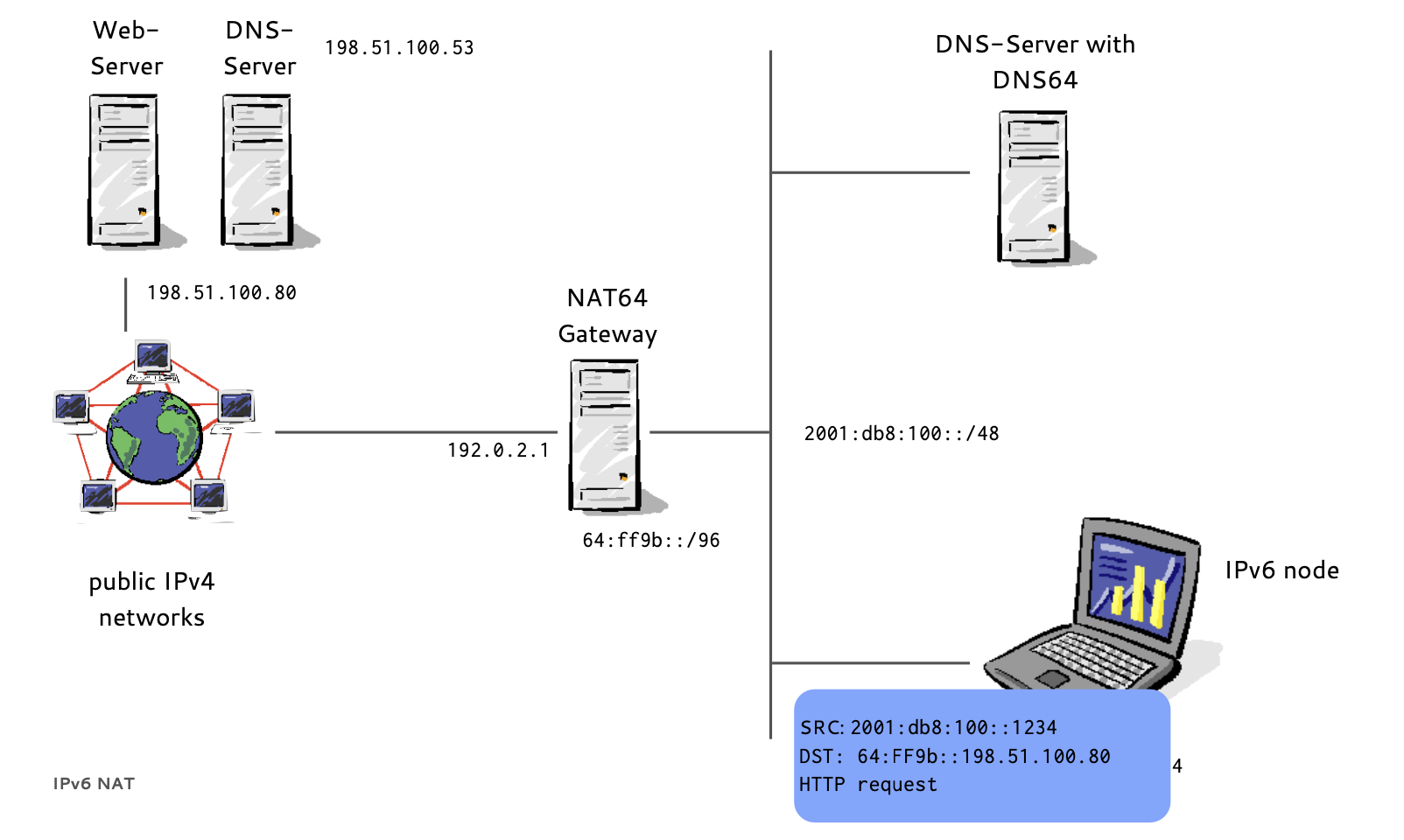
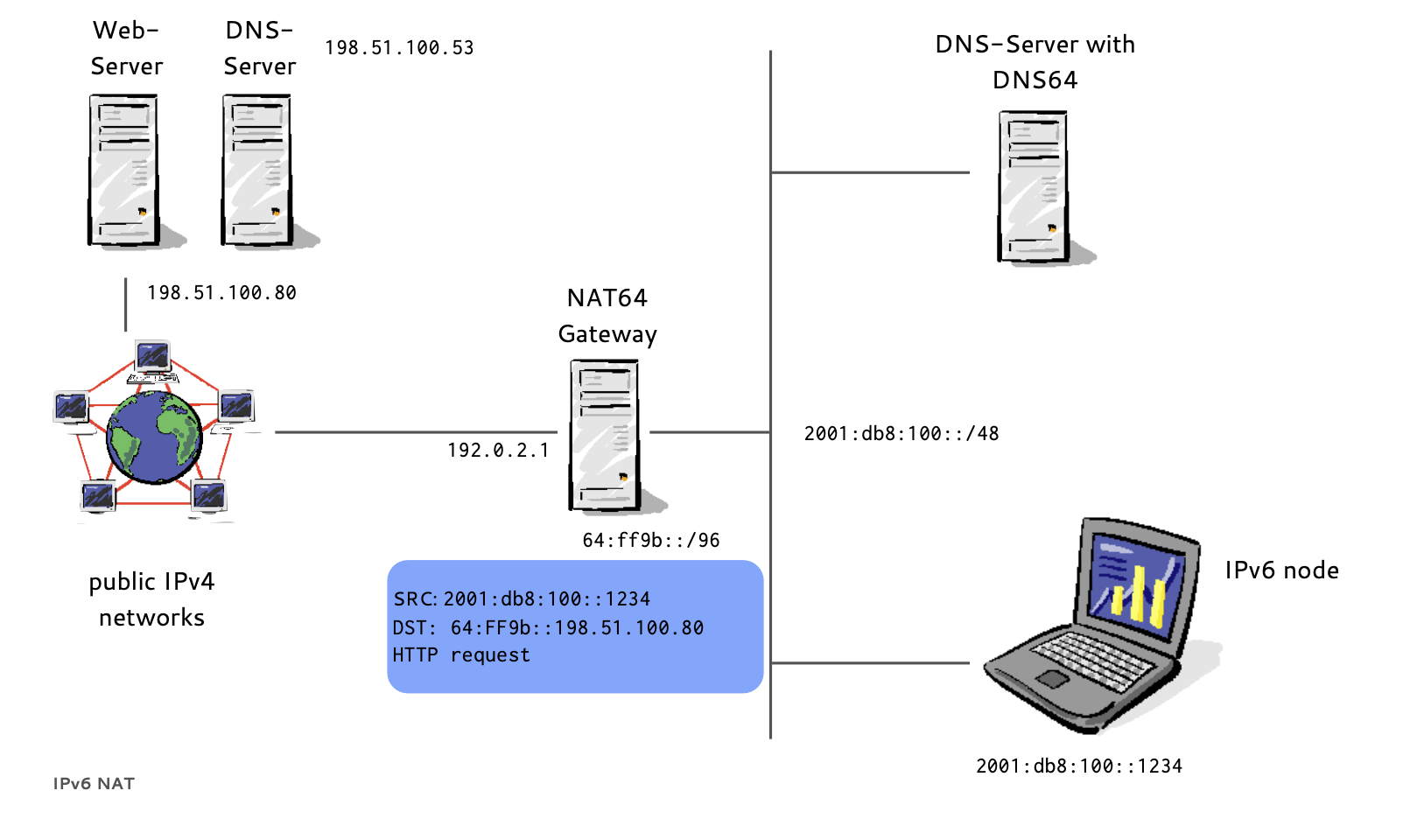
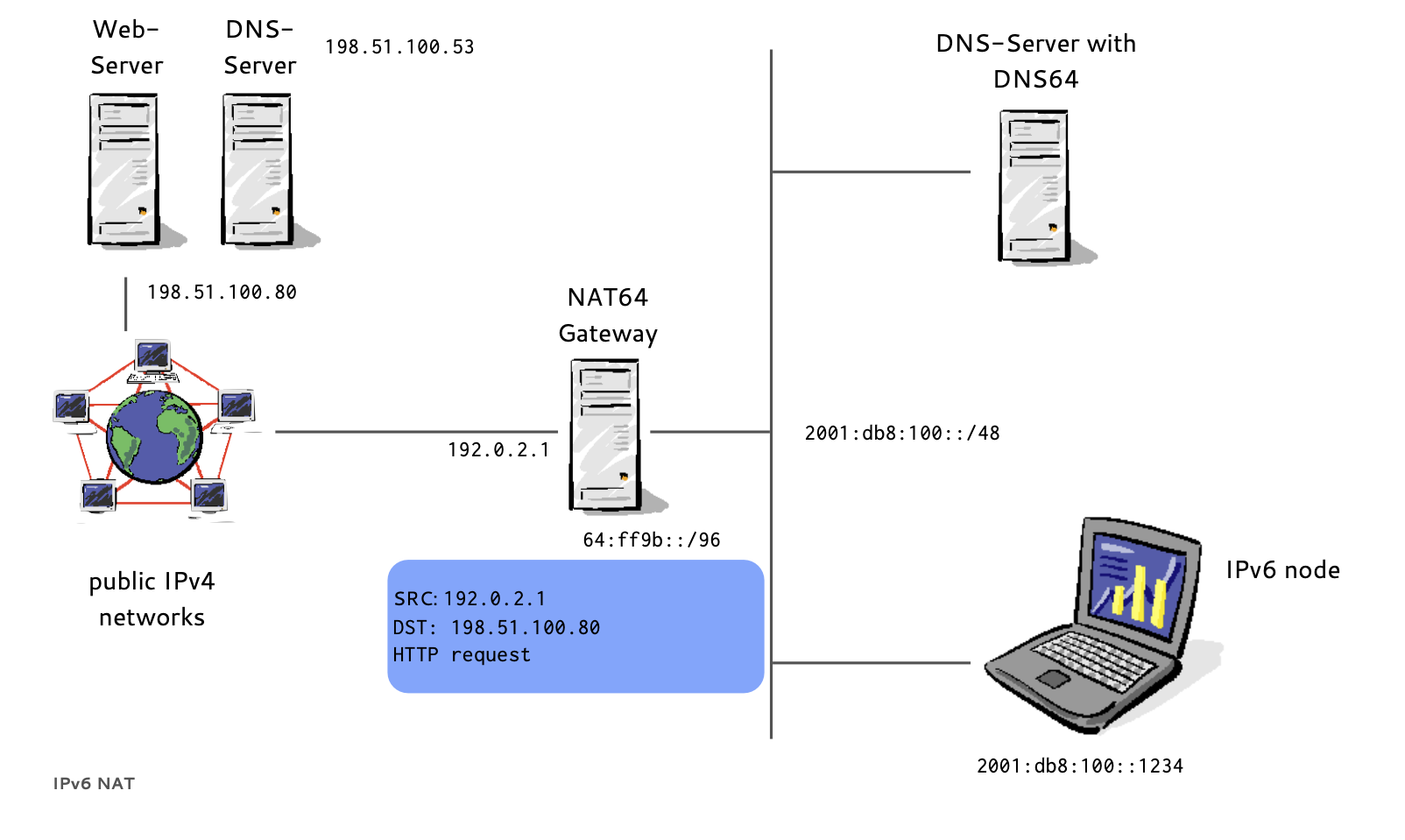
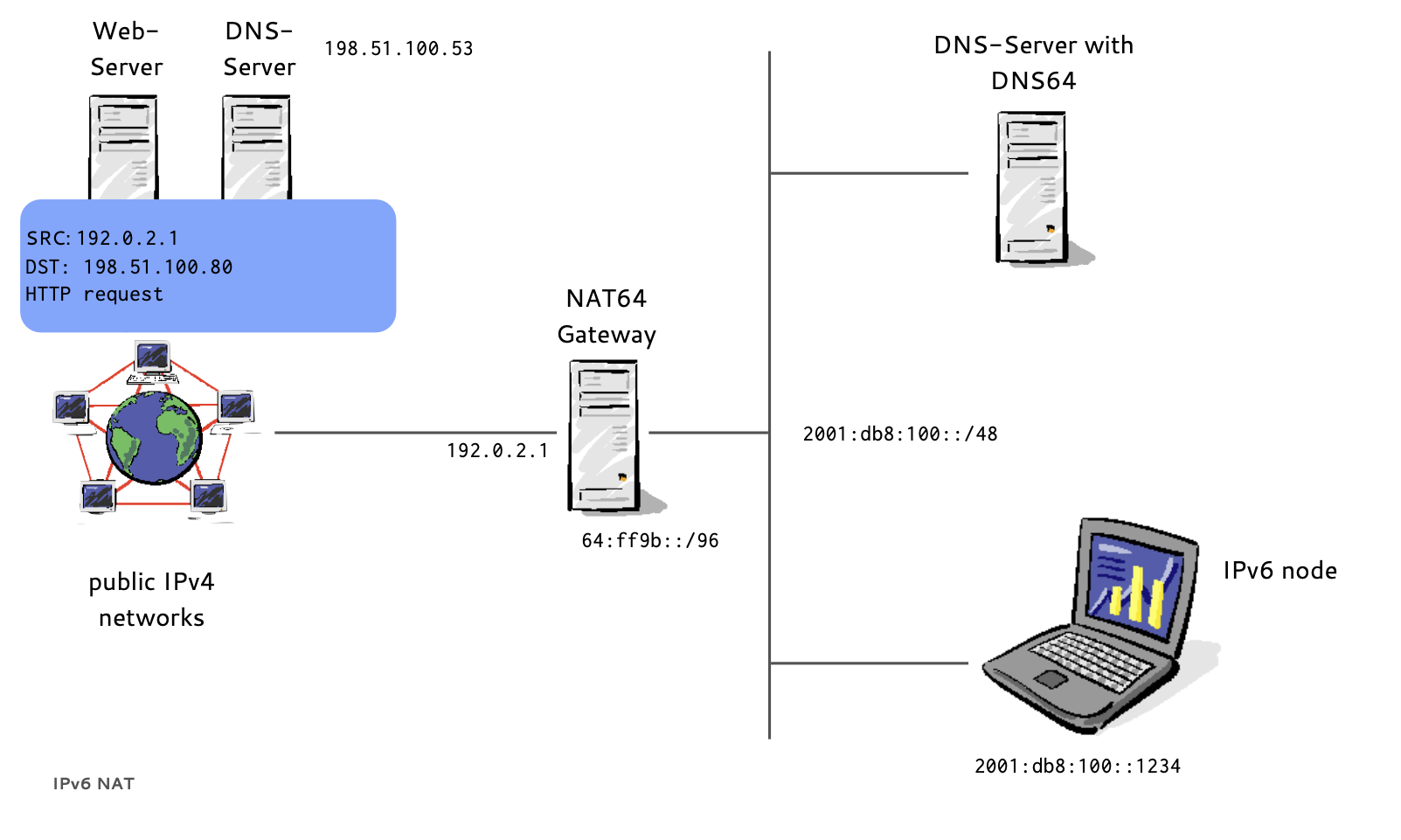
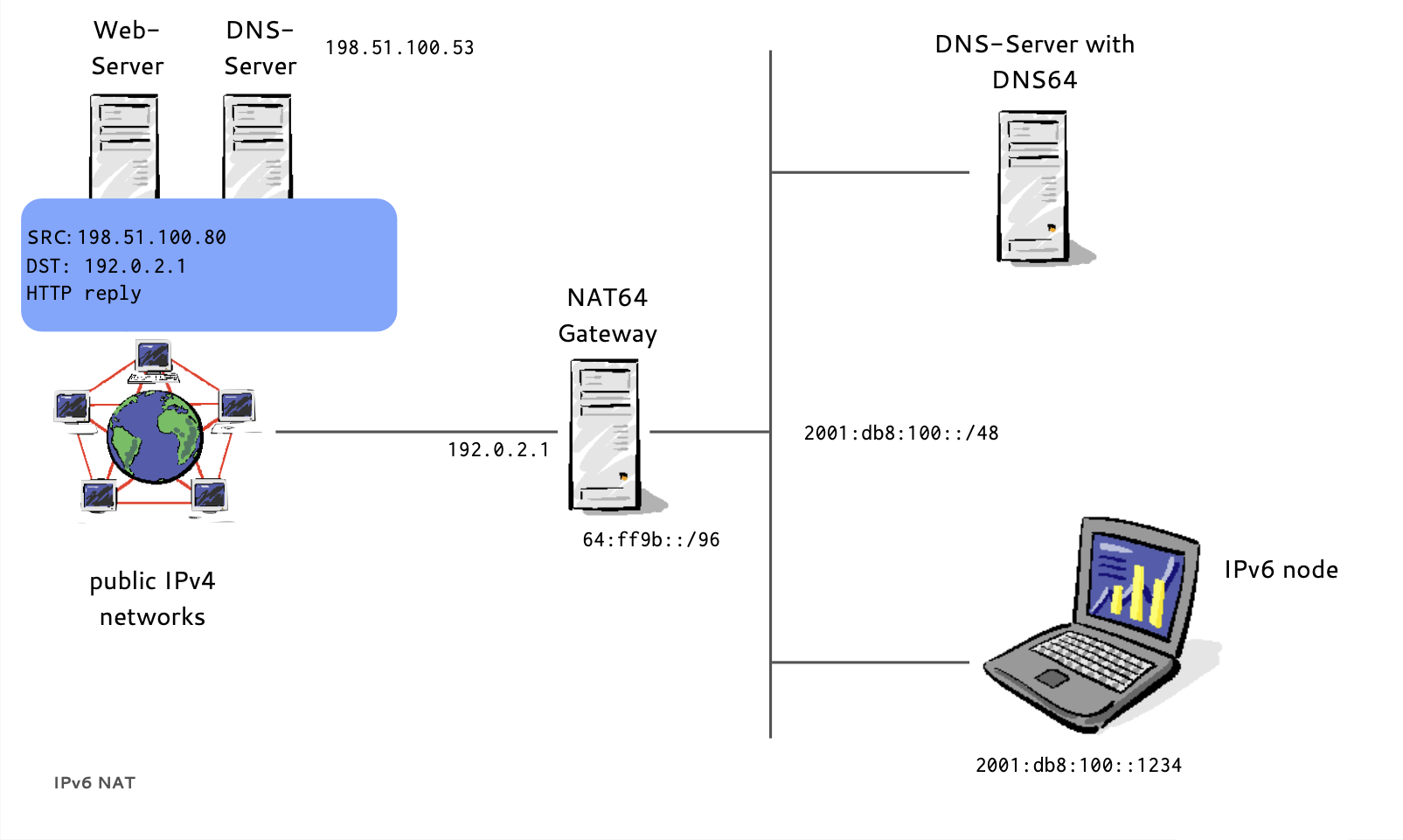
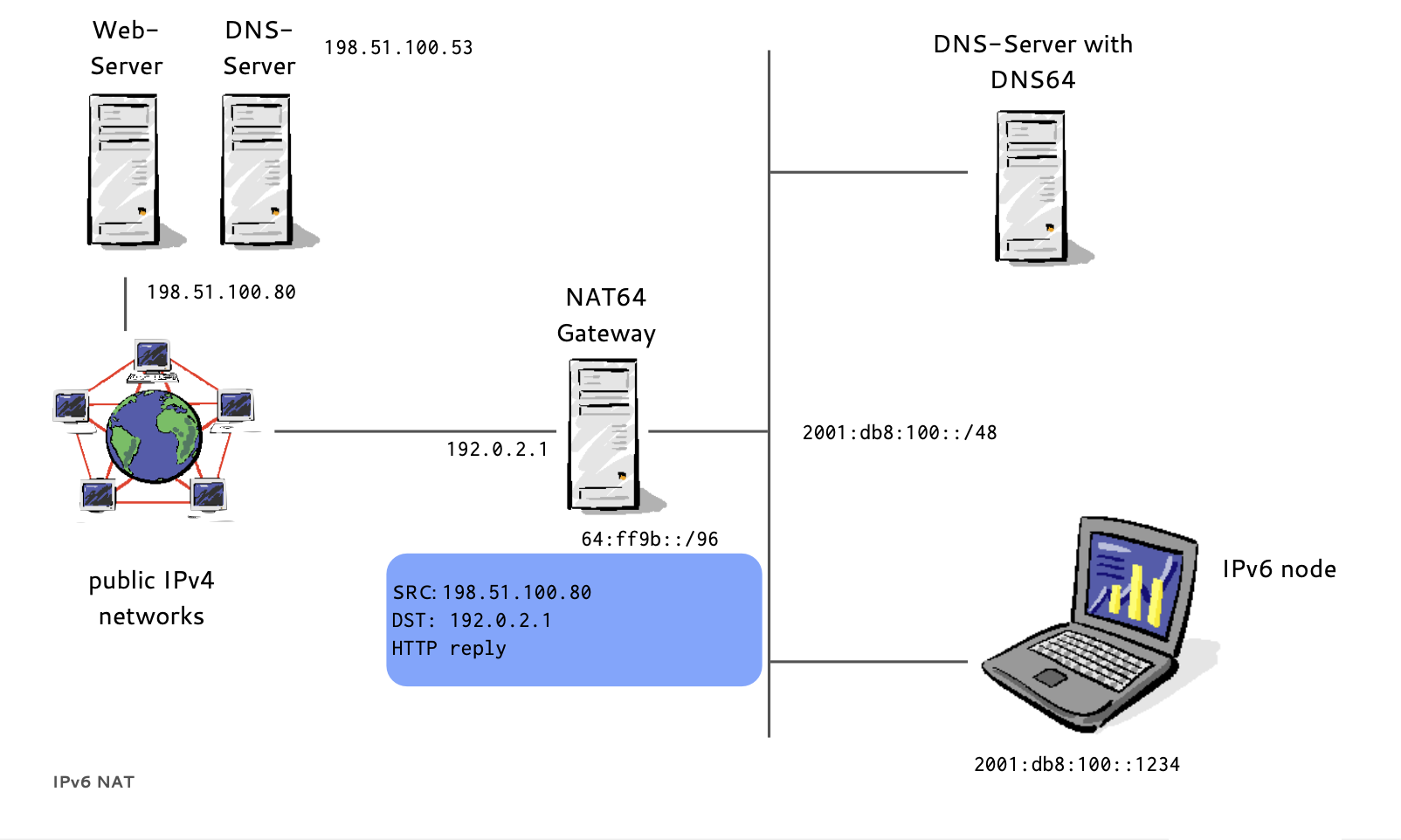
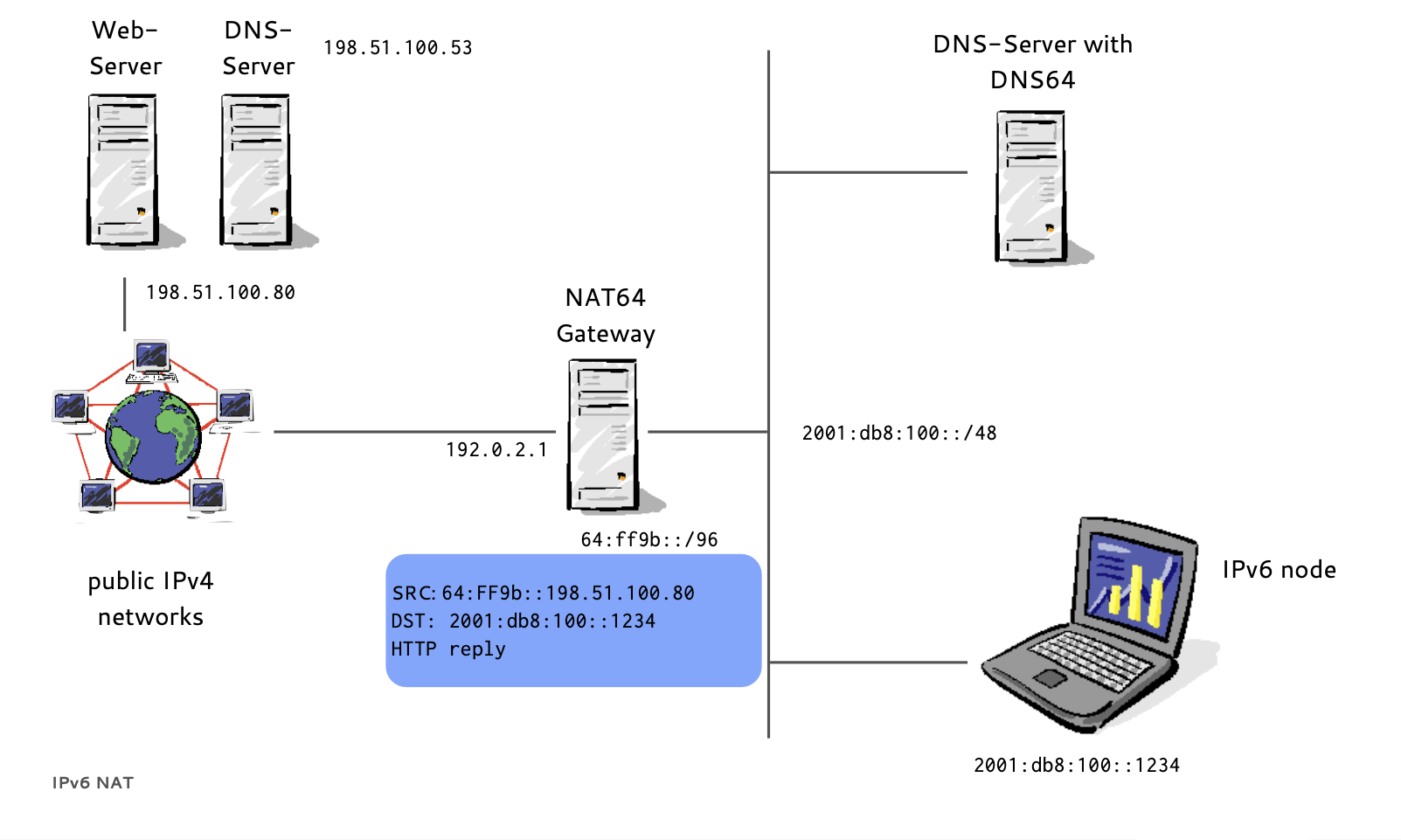
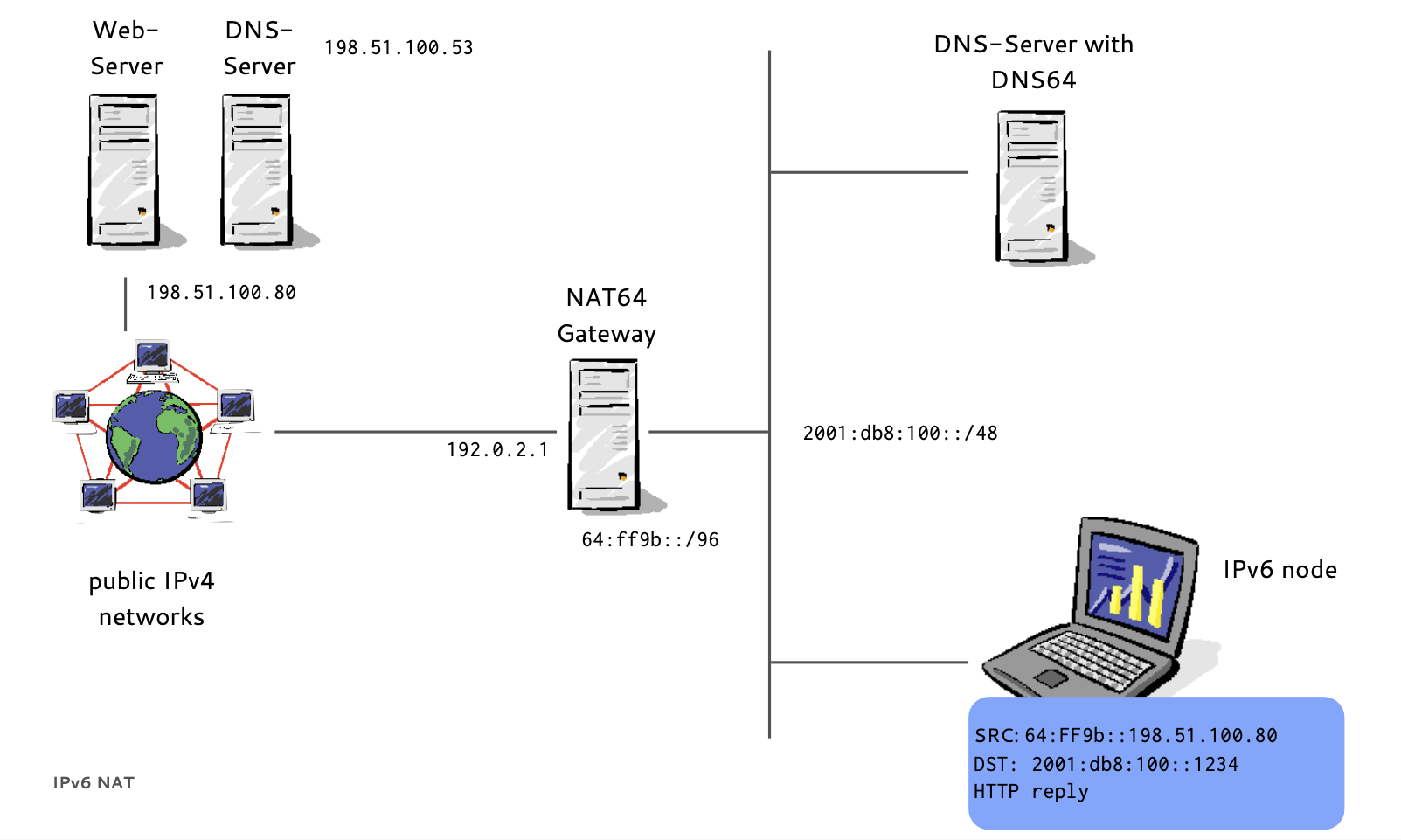
- DNS64 and NAT64 are used to connect IPv6 only hosts to IPv4 only systems on the Internet
- DNS64 translates DNS request
- NAT64 does Network Address Translation
DNS64 / NAT64
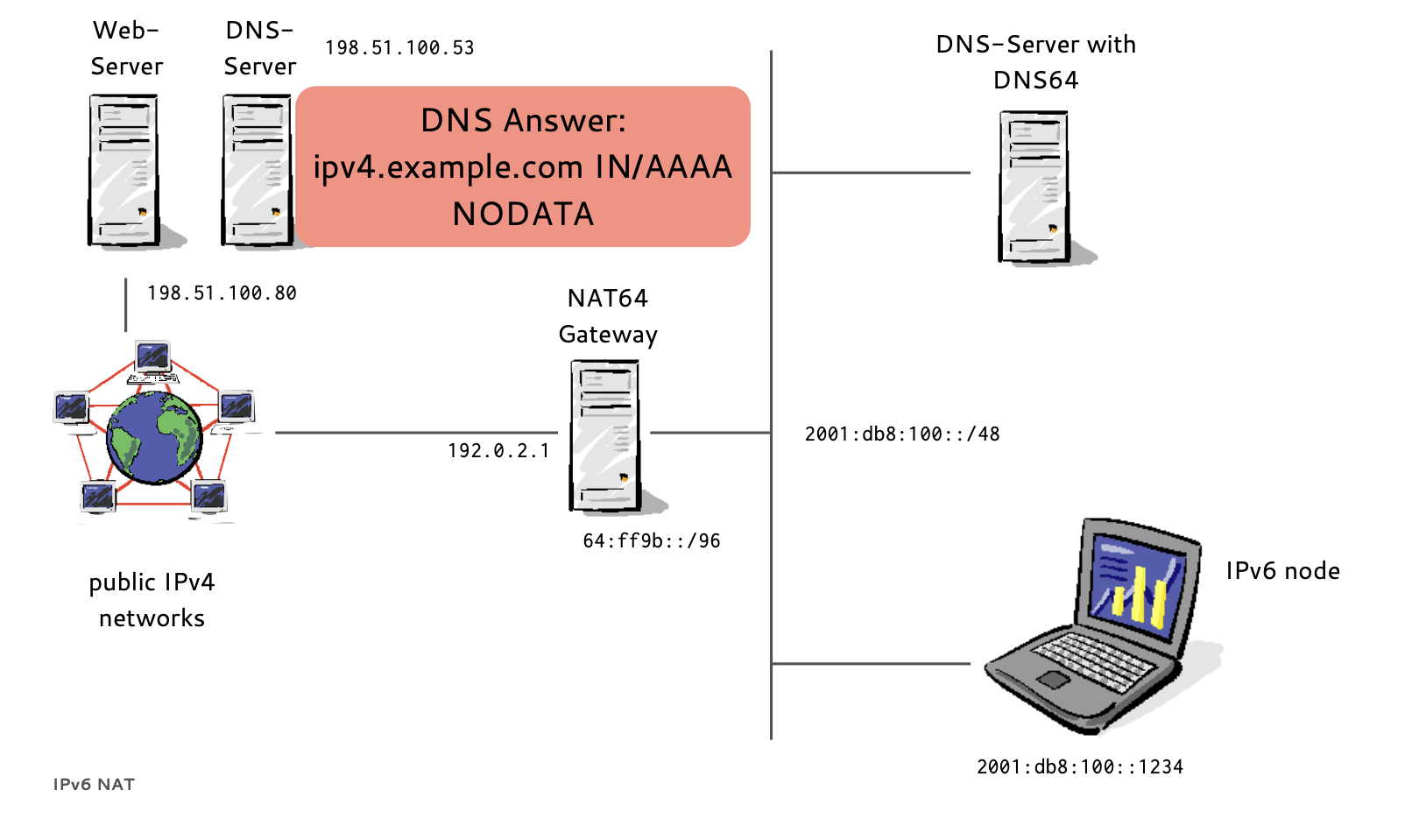
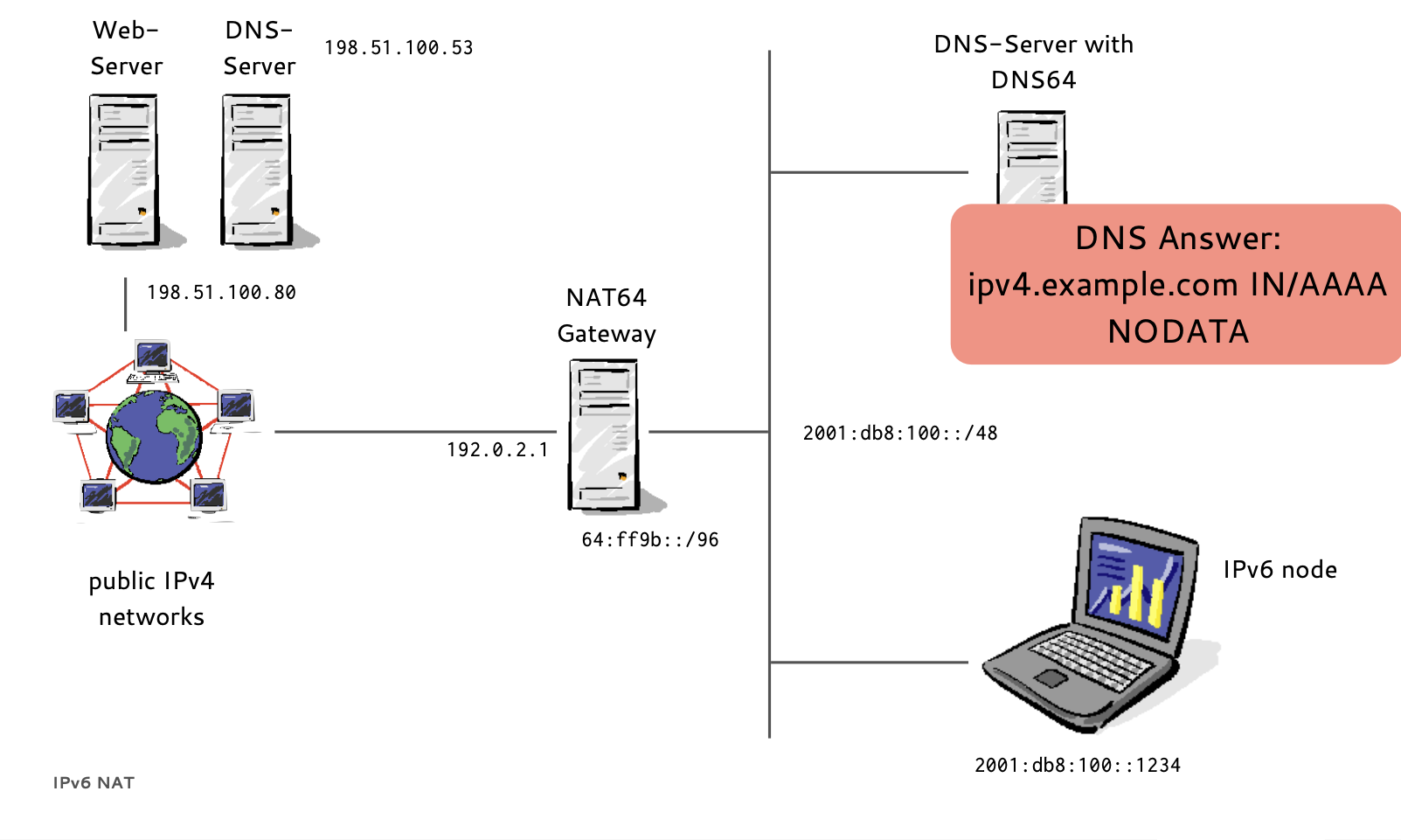
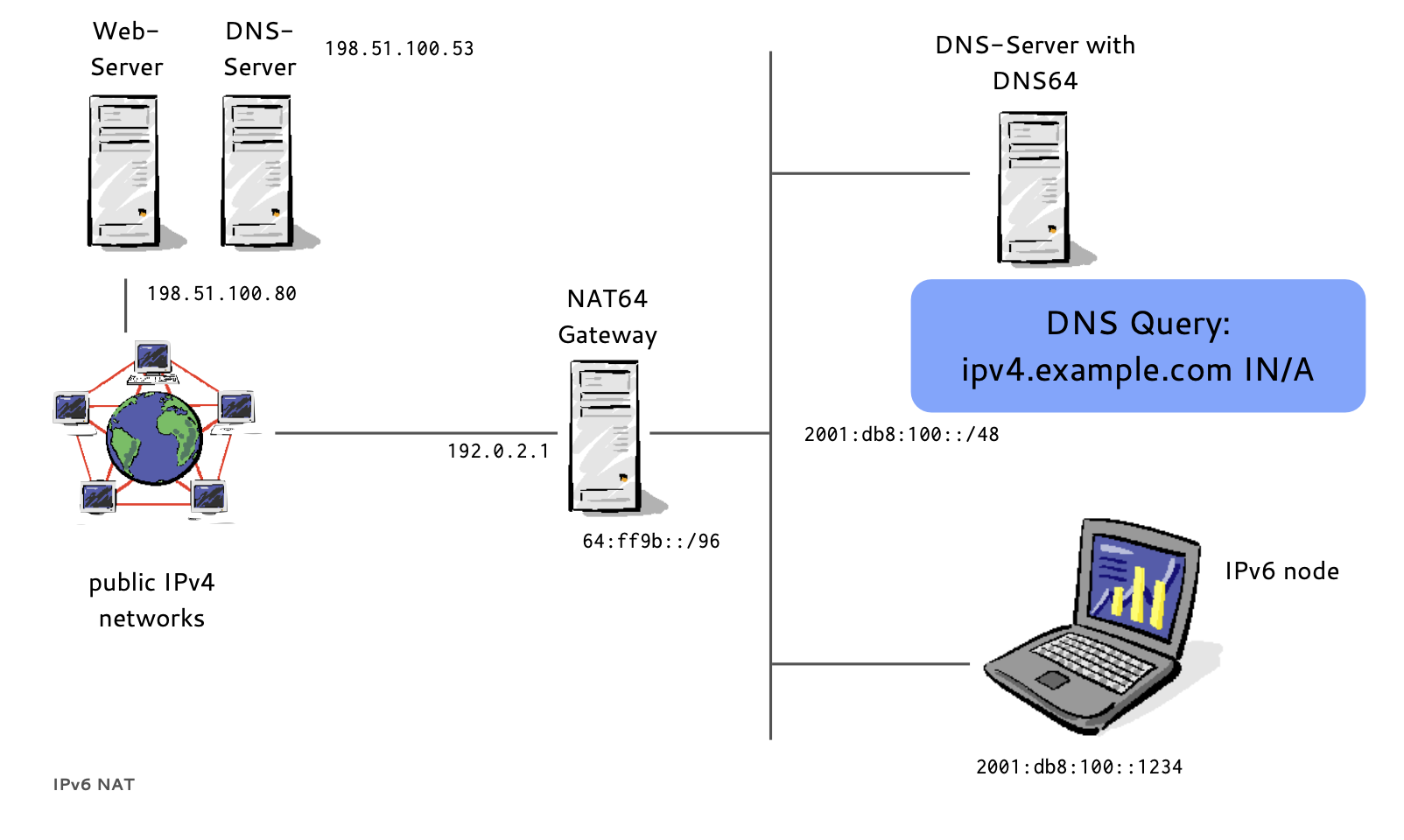
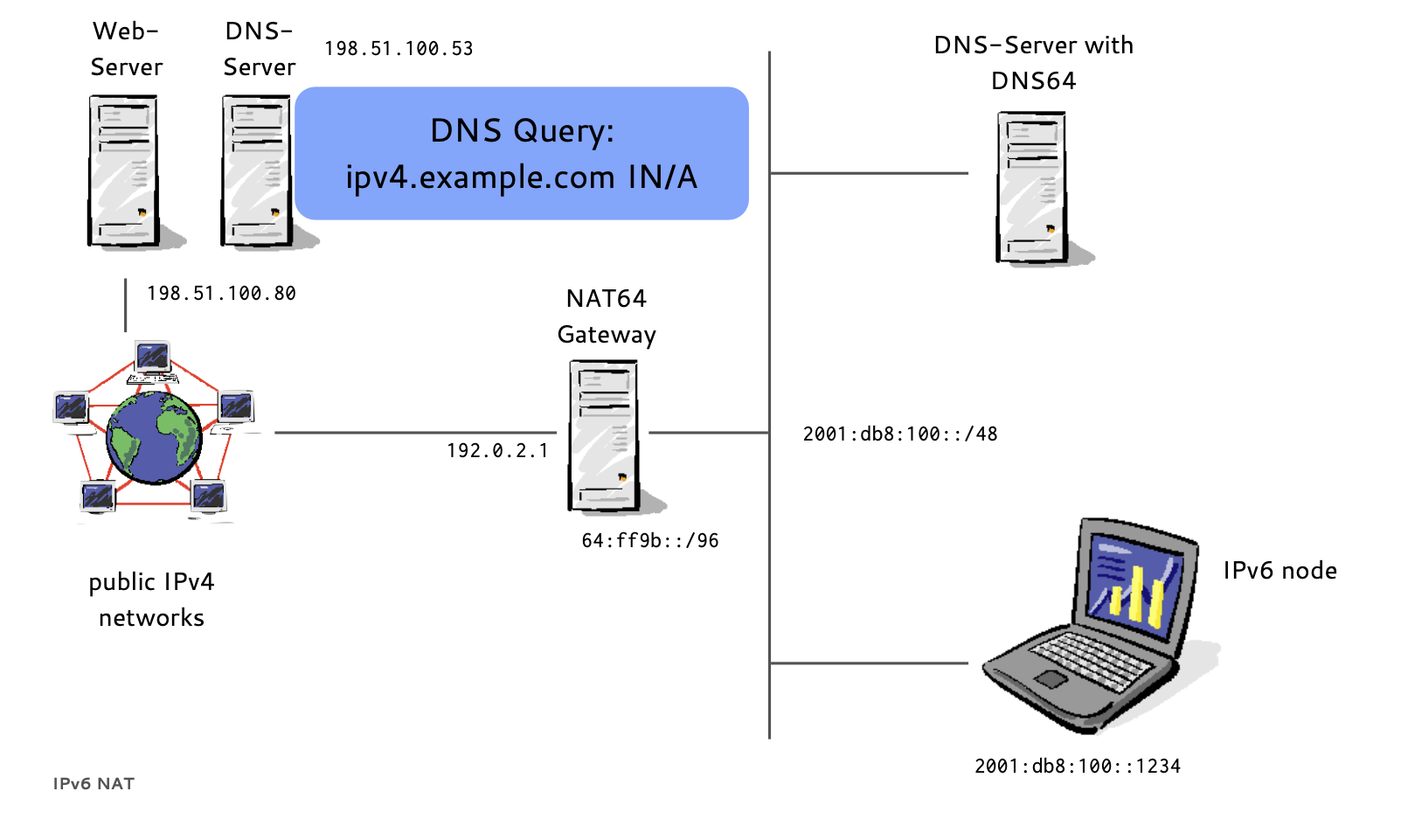
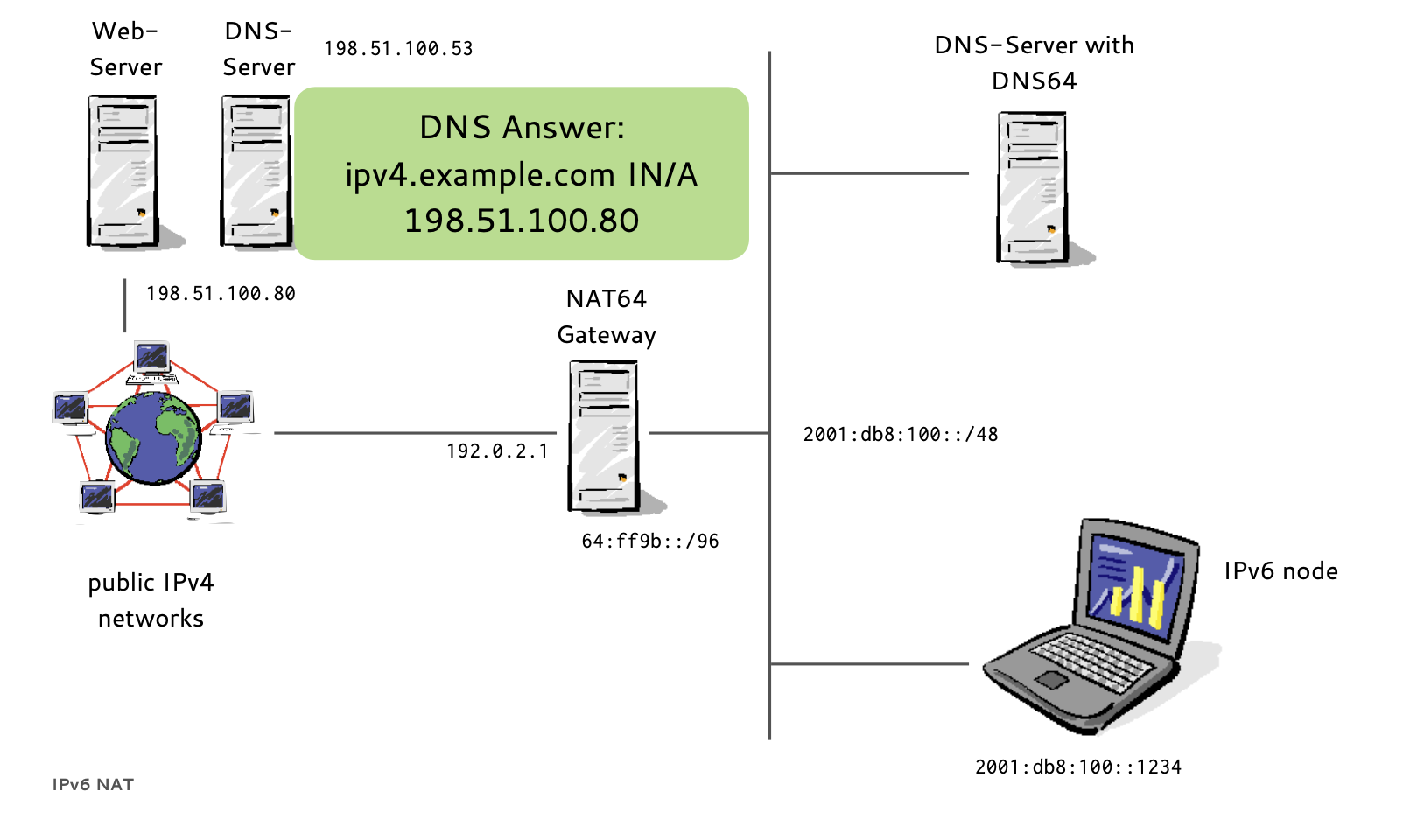
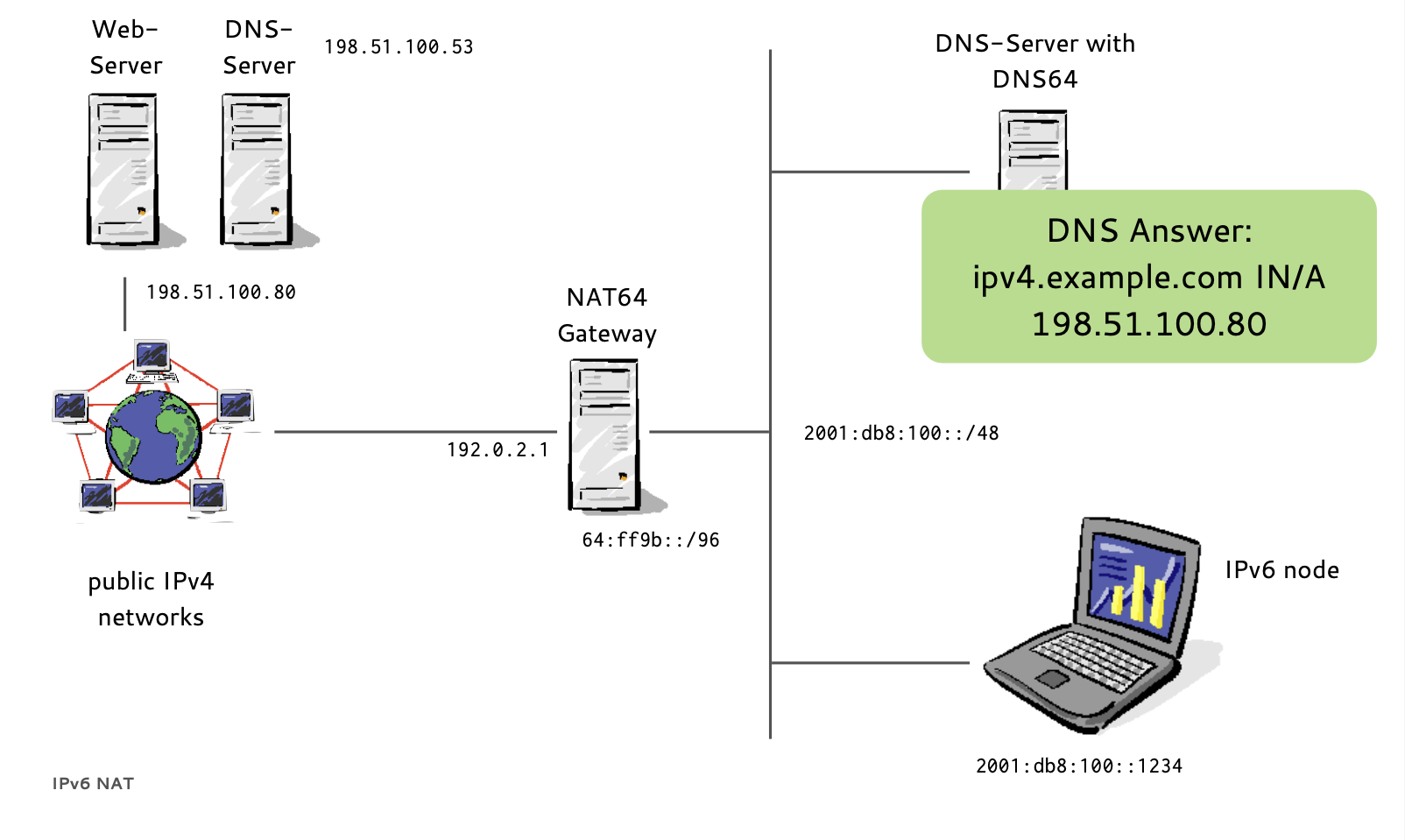
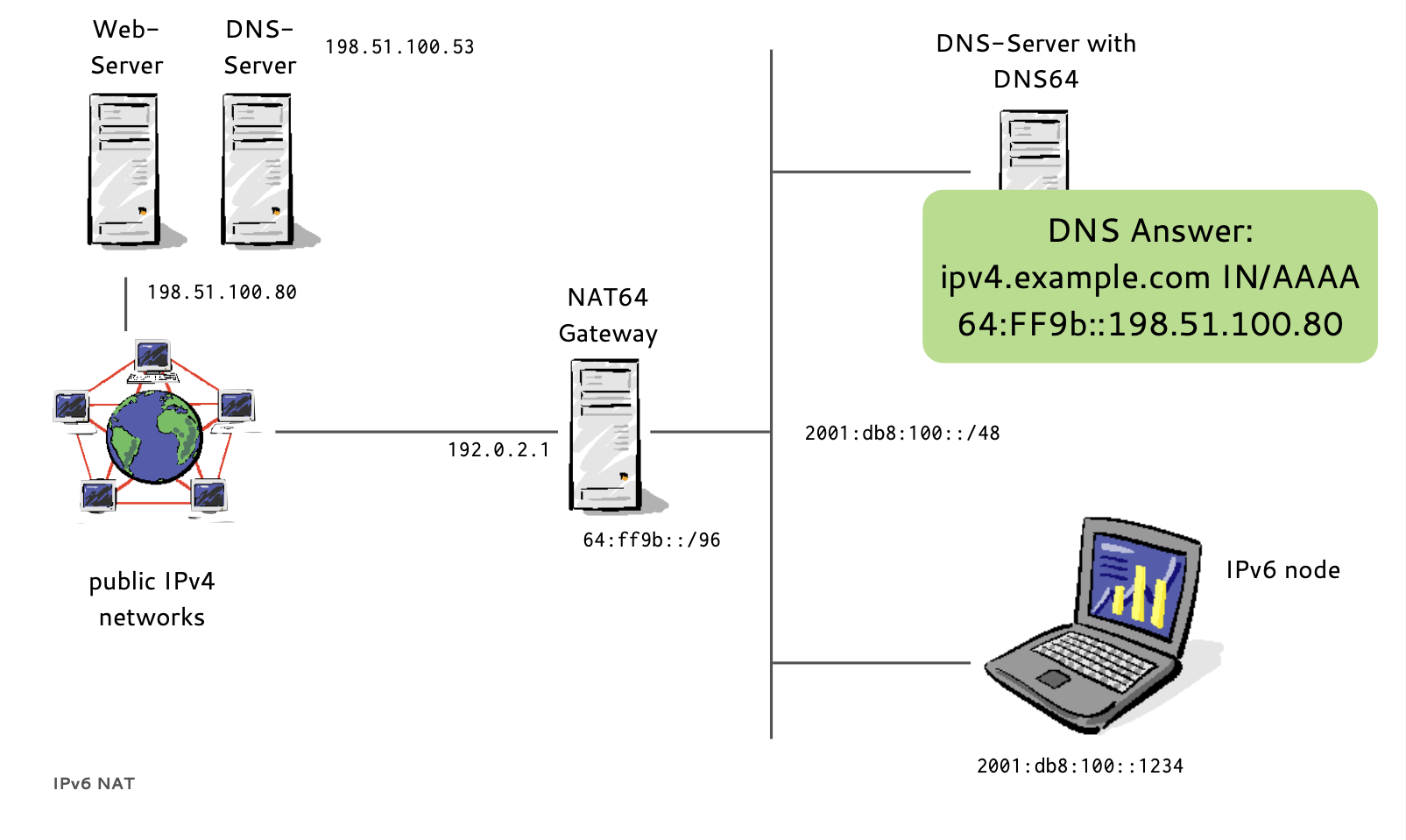
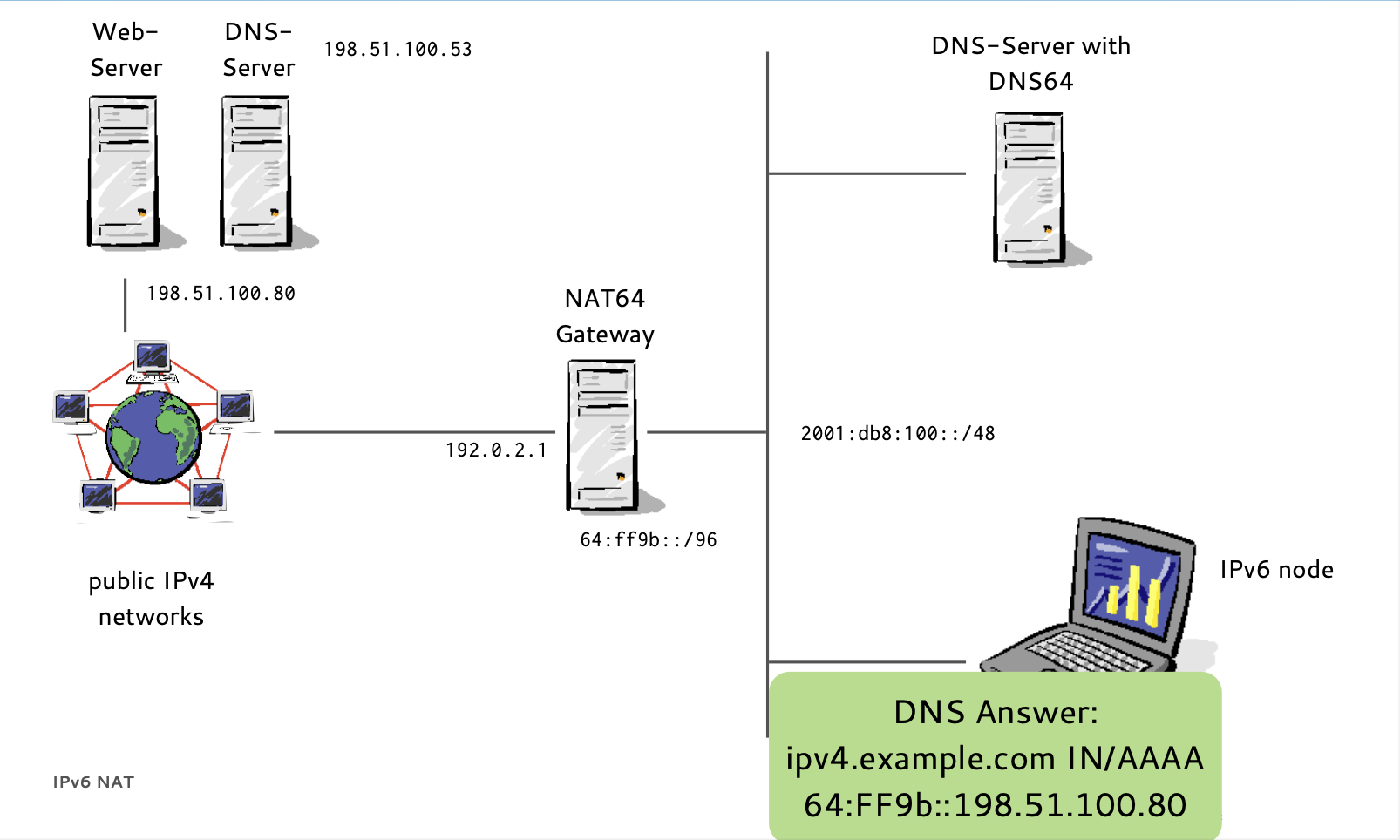
- If a host has no IPv6 AAAA-Record in DNS
- Instead of returning "NODATA", a DNS64 DNS Server translates IPv4 A-Records to IPv6 AAAA-Records
- A NAT64 Gateway translates between the 'synthesized' IPv6 Addresses and the real IPv4 host between IPv6 and IPv4
DNS64/NAT64 example (1/19)
DNS64/NAT64 example (2/19)
DNS64/NAT64 example (3/19)
DNS64/NAT64 example (4/19)
DNS64/NAT64 example (5/19)
DNS64/NAT64 example (6/19)
DNS64/NAT64 example (7/19)
DNS64/NAT64 example (8/19)
DNS64/NAT64 example (9/19)
DNS64/NAT64 example (10/19)
DNS64/NAT64 example (11/19)
DNS64/NAT64 example (12/19)
DNS64/NAT64 example (13/19)
DNS64/NAT64 example (14/19)
DNS64/NAT64 example (15/19)
DNS64/NAT64 example (16/19)
DNS64/NAT64 example (17/19)
DNS64/NAT64 example (18/19)
DNS64/NAT64 example (19/19)
DNS64/NAT64
- NAT64 and DNS64 do not share any state
- Bridges the gap between "IPv6 only" and "IPv4 only" networks
The IP protocols
IPv4 world
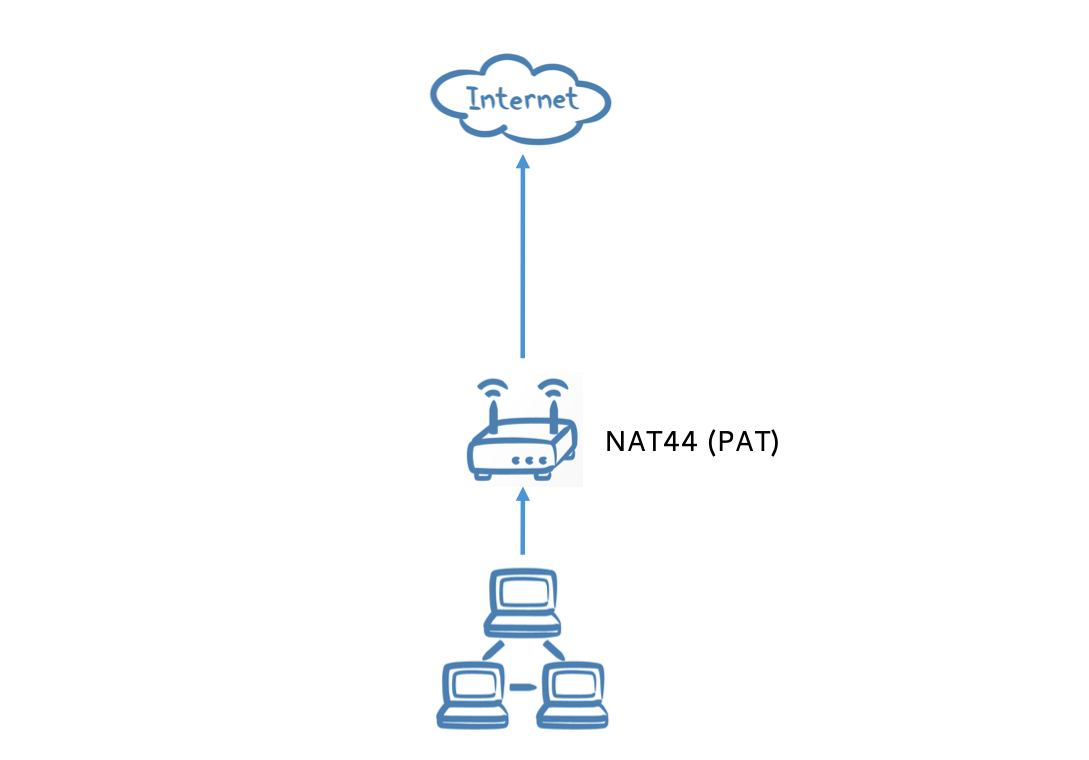
IPv4 world today as envisioned by the IETF in 1996
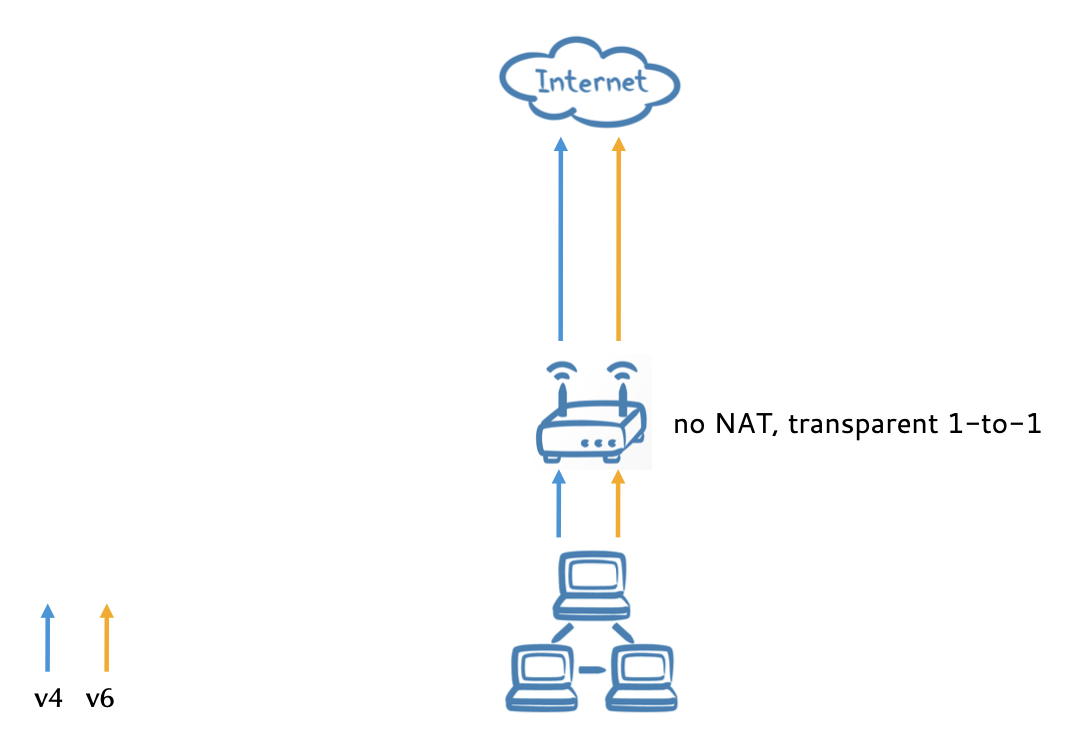
Dual-stack issues
- The Internet is still growing
- New customers need to be connected
- Some "content" is still available on IPv4
- But no new IPv4 addresses are available
IPv4 for access networks
- Service provider try to find solutions to deliver IPv4 access over IPv6 only access networks
- Several solutions have been (and are developed) in the IETF:
- DS-Lite/lightweight DS-Lite
- 464XLAT
- 4rd
- MAP-E and MAP-T
Dual-Stack-Lite (DS-Lite)
DS-Lite
- DS-Lite is specified in RFC 6333 "Dual-Stack Lite Broadband Deployments Following IPv4 Exhaustion"
- DS-Lite provides IPv4 access over IPv6 using NAT and IPv4-in-IPv6 tunnel
- Works with unmodified, legacy IPv4 applications and devices
DS-Lite
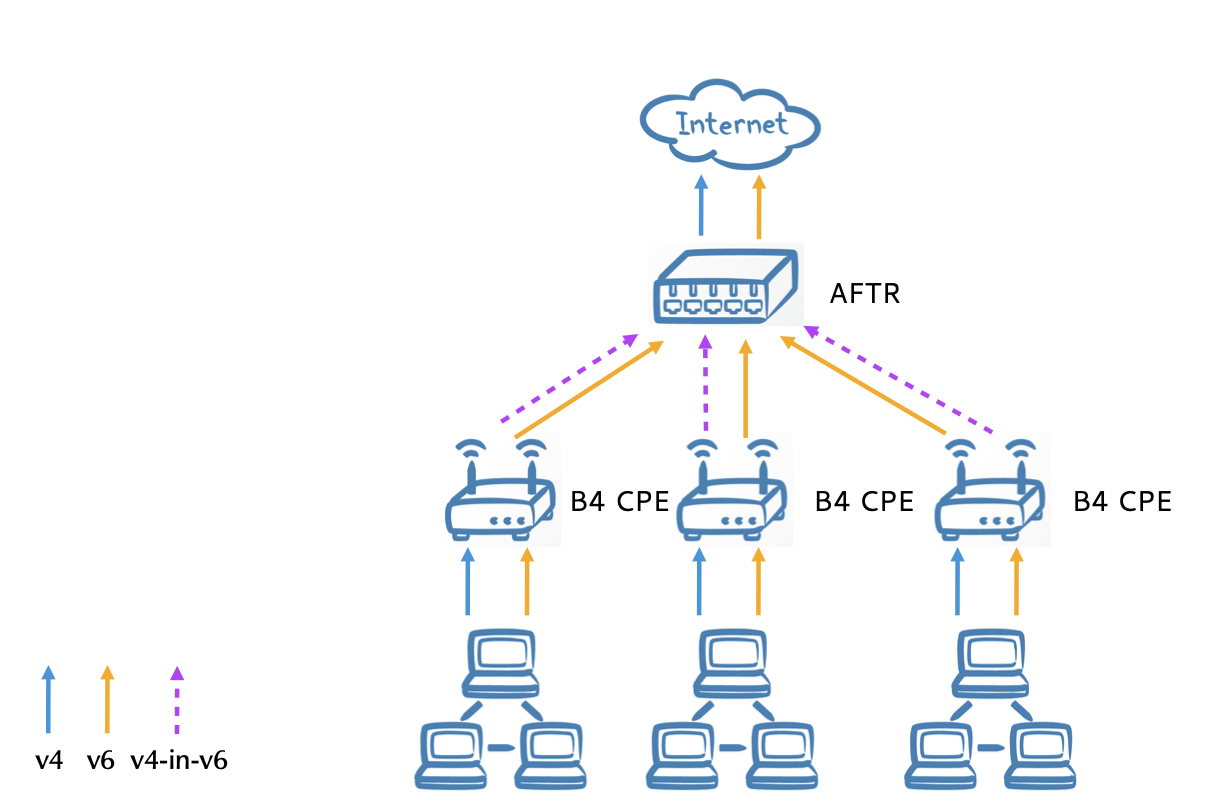
Dual-Stack Lite modules
- B4 ("Basic Bridging BroadBand"")
- Usually build into CPE devices (CPE: Customer Premises Equipment)
- Can also run on standard PC hardware
- Purpose:
- Find the other end of the tunnel
- Encapsulate IPv4 in IPv6
- No NAT on the B4 element!
Dual-Stack Lite modules
- AFTR (Address Family Transition Router)
- Establish tunnel with many B4 elements
- Accept and decapsulate IPv6 tunnel traffic
- NAT between customer IPv4 and the IPv4 Internet
MAP-E
What is MAP-E
- MAP-E is defined in RFC 7597 "Mapping of Address and Port with Encapsulation (MAP-E)" (Standards Track)
- MAP-E (Mapping of Address and Port with Encapsulation) is a protocol that allows IPv4 packets to be transported across an IPv6 network using encapsulation.
- MAP-E helps alleviate the issue of IPv4 address exhaustion by allowing multiple customer premises equipment (CPE) to share the same public IPv4 address through Carrier-Grade NAT.
MAP-E
- In a MAP-E deployment, a MAP-E CE device (such as a router) uses a Basic Mapping Rule (BMR) to configure itself with an IPv4 address, prefix, or shared IPv4 address from an IPv6 prefix.
- The BMR can also be used for forwarding packets in scenarios where an IPv4 source address and source port are mapped into an IPv6 address/prefix.
MAP-E
- MAP-E is an alternative to Carrier-grade NAT and DS-Lite, pushing the IPv4 IP address/port translation function into the existing customer premises equipment IPv4 NAT implementation, thus avoiding the NAT444 and statefulness problems of carrier-grade NAT.
MAP-E
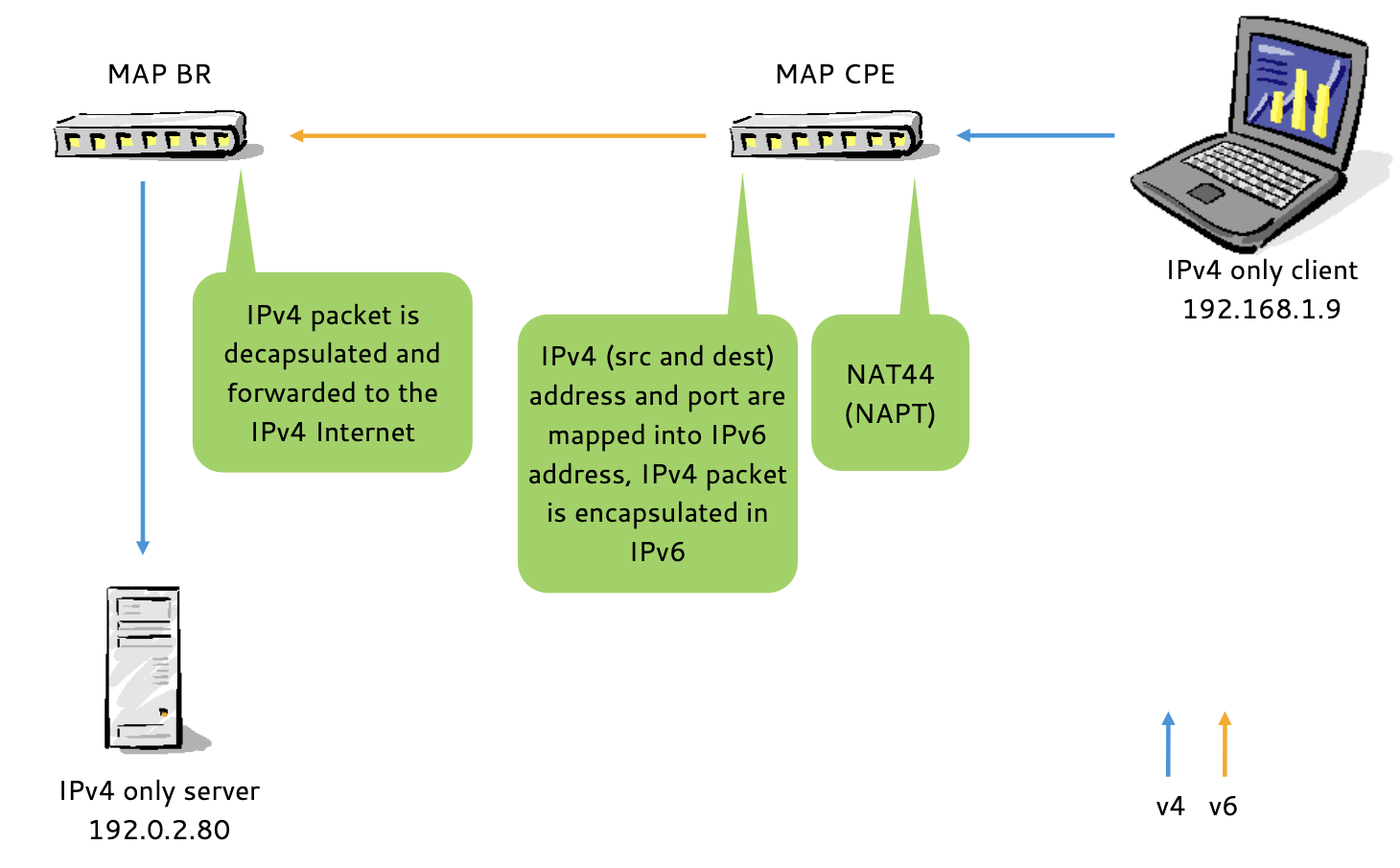
MAP-E
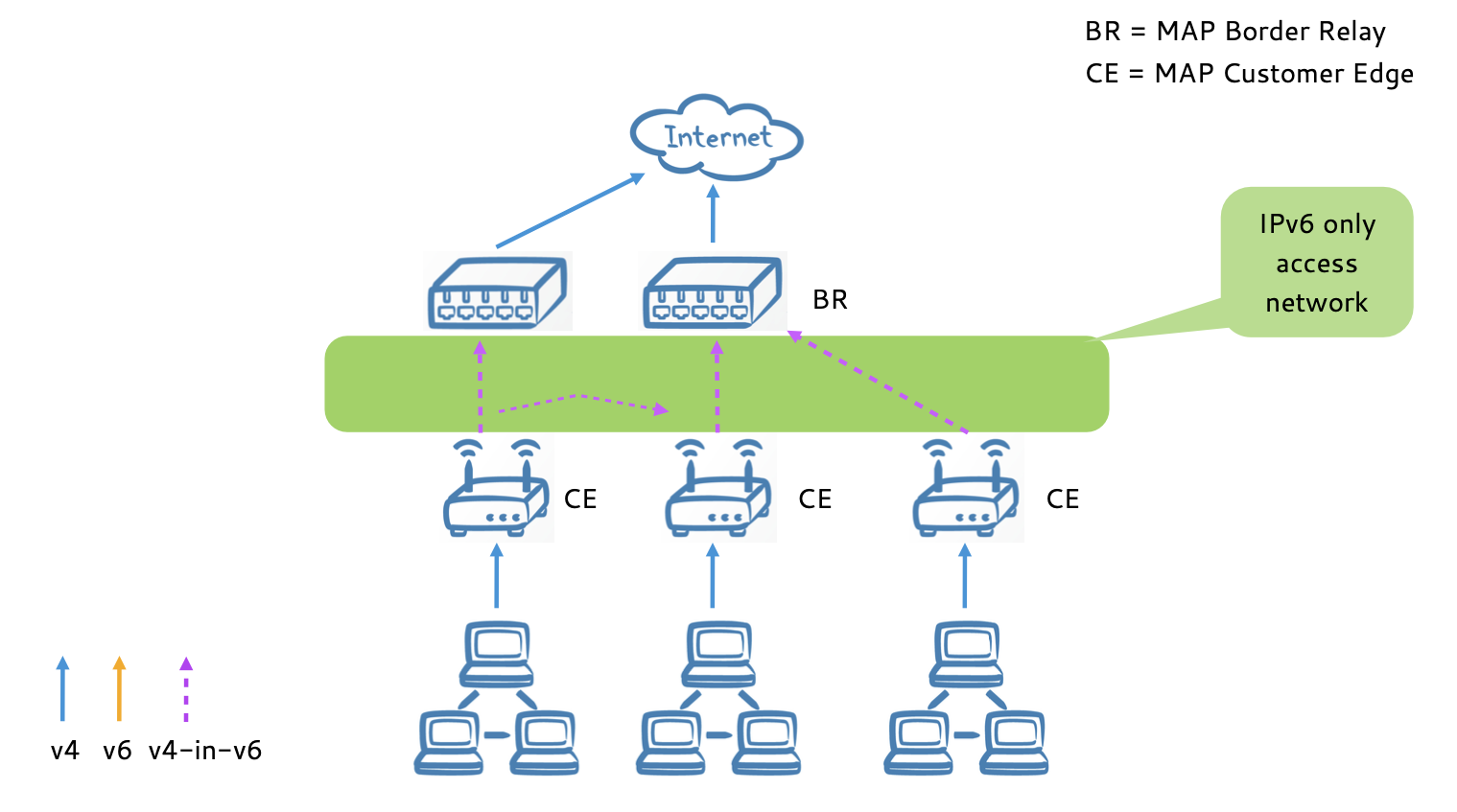
MAP-E
- MAP-E supports
- Shared IPv4 addresses (multiple CEs sharing one IPv4 address) on the BR (Border Relay)
- The customer edge device (CE) performs NAT44
- Each CE negotiates with the BR a UDP/TCP port range assigned it can use
- Shared IPv4 addresses (multiple CEs sharing one IPv4 address) on the BR (Border Relay)
- A single IPv4 address per CE configured on the BR
- An IPv4 prefix per CE configured on the BR
MAP-E
- The default MAP mode of operation is a "hub-and-spoke" mode (BMR - basic mapping rule)
- All traffic from a CE must pass a BR for forwarding
- Additionally, there can be one or more "forwarding mapping rules (FMR)" installed on the CEs to enable a "mesh" mode
- Traffic can be forwarded between CEs between passing through a (central) BR
MAP-E
- The MAP parameters and IPv4 address(es) for the CE are be provisioned via
- DHCPv6
- "TR-69" Broadband Forum's Residential Gateway management interface
- XML-RPC over IPv6
Carrier Grade NAT (CGN)
CGN
- Carrier Grade NAT is a label given to IPv4 depletion mitigation technologies that require network address translation at the provider end of an access network
- Examples:
- NAT444 (NAT IPv4-to-IPv4 at the CPE, another NAT IPv4-to-IPv4 at the Border Router)
- (original) DS-Lite
- 4rd
Challenges with CGN
- CGN creates service regression for network functions or services
- Many network functions can break or have non-optimal performance in CGN environments
- RFC 6269 "Issues with IP Address Sharing" gives additional details
Challenges with CGN
- Restricted allocations of outgoing ports will impact performance for end-users
- Incoming port negotiation mechanisms may fail
- Incoming connections to Assigned Ports will not work
- Port discovery mechanisms will not work
- Assumptions about parallel/serial connections may fail
- Reverse DNS will be affected
- Inbound ICMP will fail in many cases
Challenges with CGN
- Amplification of security issues will occur
- Fragmentation will require special handling
- Single points of failure and increased network instability may occur
- Port randomization will be affected (DNS cache poisoning)
- Frequent keep-alives will reduce mobile device battery life
Challenges with CGN
- Service usage monitoring and abuse logging will be impacted for all
elements in the chain between service provider and content provider
- Penalty boxes will no longer work
- Spam blacklisting will be affected
- Geo-location services will be impacted
- Geo-proximity mechanisms will be impacted
- Traceability of network usage and abusage will be affected
- IPv6 transition mechanisms will be affected
Deprecated IPv6 NAT technologies
Deprecated IPv6 NAT technologies
- Network Address Translator - Protocol Translator (NAT-PT) and
Network Address Port Translator - Protocol Translator (NAPT-PT) has
been defined in the beginning of IPv6 NAT design work (RFC 2766,
February 2000)
- NAT-PT and NAPT-PT have several security and scalability issues, which lead to deprecation of these NAT solutions
- NAT-PT and NAPT-PT have been moved to historical status in RFC 4966 (July 2007)
Questions?